
BEYOND THE CLASSROOM
How the Hill Grant Transformed Place-Based Learning at K
By Andy Brown
Victoria Gutierrez ’28 stood at the U.S.-Mexico border in San Diego, watching the stark transformation of the landscape. Vibrant street art and bustling city life gave way to gray concrete, barbed wire and the imposing presence of Border Patrol agents. As she crossed into Tijuana with her classmates, Gutierrez—then a first-year student at Kalamazoo College—couldn’t help but think of her father, who made a similar journey several years earlier as a teenager, seeking a better life.
“It was very intense,” Gutierrez said. “As we’re walking in, the walls get tighter and everything’s made of metal. It’s intimidating, but it was easy for us to get in because we all have American passports.”
That night, Gutierrez and her classmates stayed at Casa del Migrante, a shelter for migrants and their families. She spent the evening playing Duck, Duck, Goose and other games with children living there, communicating through laughter and gestures despite her limited Spanish. The experience was joyful and heartbreaking in equal measure.
“These children were just clinging to me the whole night,” she said. “They’re so innocent, and they’re being brought into a world that wants to keep them separate. They’re no different from my nieces and nephews in America. It was a sad reality.”
This was exactly the kind of transformative experience that Associate Professor of English Shanna Salinas, Associate Professor of Sociology Francisco Villegas, and Professor Emeritus of English Bruce Mills envisioned when they codeveloped the Humanities Integrated Locational Learning (HILL) Project in 2021.
A Vision for Experiential Humanities
The HILL Project began with a simple but powerful question: How could K leverage its deep commitment to experiential learning and social justice to demonstrate the real-world relevance of humanities education?
“This is especially important during a time when undergraduates are striving to engage in experiences addressing community needs—often in response to growing economic and social inequities—while at the same time fostering the knowledge, skills and, importantly, personal relationships that support future professional aims,” Mills said.
With a $1.297 million grant from the Andrew W. Mellon Foundation’s Humanities for All Times initiative, these faculty and some of their colleagues developed an innovative curriculum that dispersed students within New Orleans, St. Louis, San Diego and Kalamazoo. Each site offered distinctive opportunities to explore issues of location and dislocation while examining how histories, geographies and populations shape communities and the social justice work happening within them.
The grant was one of just 12 awarded to liberal arts colleges nationwide, selected from 50 invited proposals. The Mellon Foundation’s vision aligned perfectly with K’s educational mission, which aimed to show students that humanities methods aren’t just academic exercises, but crucial tools for understanding and addressing societal challenges.
Building Ethical Partnerships
From the beginning, the HILL project represented a commitment to support community partners rather than simply study them. Villegas is especially proud of the students who participated and the relationships they and the faculty built across multiple spaces.

“We were able to accompany over a hundred students across each of these locations, including Kalamazoo, and they could readily make connections between the material we teach in our classrooms and its relevance outside of it,” he said. “We were also able to support over a dozen students who returned to these sites during the summer break to develop Senior Integrated Projects and support partner organizations through research.”
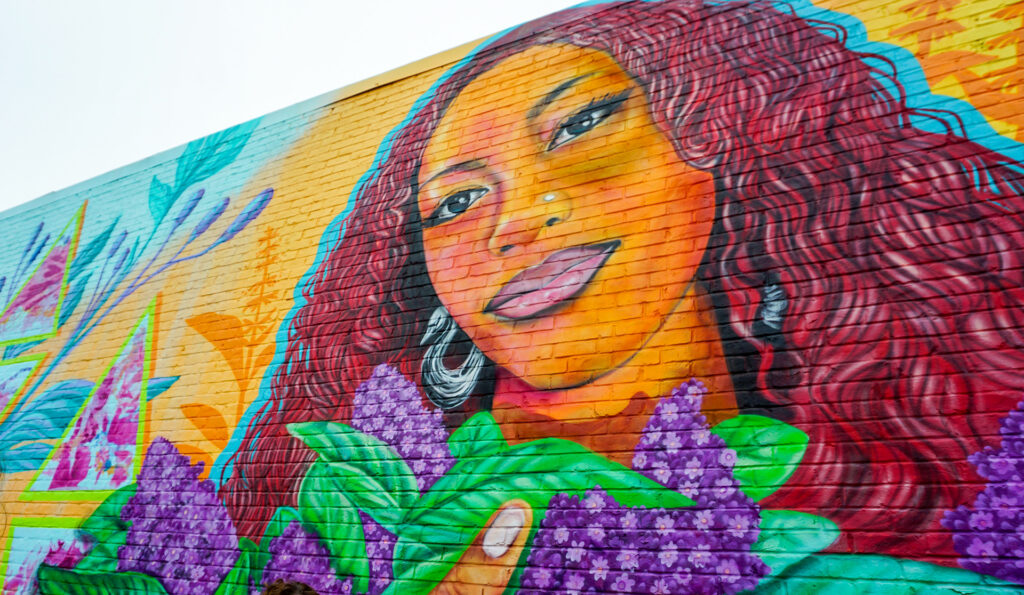
In New Orleans, for example, students worked with Monica Rose Kelly, founder and executive director of People for Public Art, a community-based mural facilitation organization. Kelly’s work focuses on empowering underserved artists—mostly teens and women, particularly women of color—to create large-scale public art that reflects and preserves the stories of the people of the community.
“We’re a very small organization, so working with students—while we can share knowledge and experience with them—really helps us a lot,” Kelly said. “They’ve been super helpful in any way that we need, from research to writing to marketing to design and sometimes on the ground, preparing work sites and painting.”

Kelly describes one mural that exemplifies the power of place-based art, a tribute to Big Chief Bo Dollis, the longtime leader of the Wild Magnolias Mardi Gras Indian Tribe, who helped bring the music and culture of the Mardi Gras Indians to international audiences. The mural became such a beloved landmark that the city renamed the street corner in his honor.
“I feel like the definition of success with public art is honoring a person and a place to the level that the community begins to celebrate them in that place and remember their story and that they belonged there,” she said.
The Power of Physical Presence
For students, the HILL project’s impact went far beyond what they could learn from textbooks or lectures. Their physical presence in these communities transformed their understanding of social justice issues.
“So many students said, ‘I read about this issue, but I didn’t fully understand it until I saw it myself,’” Salinas said. “It was validating to see that our students were immediately able to understand the purpose of the site visits, particularly the juxtapositions and tensions that arose each day, without us having to tell them. They were making connections and grappling with these issues already. I am not only proud of our students for entering these spaces with such care and thoughtfulness, but how they articulated the impact of the curriculum and their experiences.”
Gutierrez’s experience in San Diego illustrated how direct engagement can significantly deepen students’ understanding of complex issues. Working with local organizations, she and her classmates researched institutions that provide services to immigrants and refugees. What they discovered was sobering. Many buildings meant to assist residents require official IDs for entry, websites include outdated information, and services can be difficult to navigate, even for American college students with ample resources.

The students’ work also brought them into community gardens, lowrider clubs, and the Chicano Park Museum, seeing firsthand how grassroots organizations recognize local needs and step forward to address them, despite limited resources and other hurdles. At Mundo Gardens, a community garden and social justice organization focused on empowering youth and families, Gutierrez learned about a woman who started an urban garden despite facing skepticism because she was a woman of color and a mom.
“She had to bring her kids with her to meetings because she didn’t have a babysitter,” Gutierrez said. “It was inspirational for me to see her and women like her because they’re tough and they fight.”
The experience fundamentally changed how Gutierrez thinks about social justice work.
“It encouraged me to stay more informed with what’s going on throughout the world and the country we live in,” she said. “I think it’s important to think big but act small, because if we want to create change, we should start with communities and what we do locally.”


Learning from the Land
Closer to home, students worked with Jason Wesaw, a member of the Pokagon Band of Potawatomi and an artist, who has collaborated with Professor of English Ryan Fong and Writing Center Director Bela Agosa ’17 for about four years.
“I really respect Ryan because he has a Chinese background and he’s had that full-circle type of visit back to his own homelands with some of his elder family members while learning more about his ancestors,” Wesaw said. “We personally have that in common.”
Wesaw hosts Fong’s and Agosa’s students on his tribal lands of the Pokagon Band of Potawatomi in southwestern Michigan, where he shares teachings about the Potawatomi people and their connection to the natural world.
“Working with Jason and visiting the Pokagon tribal grounds was a transformative experience each year that Bela and I took our classes there,” Fong said. “Even though we were only an hour away from campus, our students were able, with Jason’s help, to see and understand their relationship to the place of southwest Michigan in new ways. The readings we had done about history and Potawatomi culture were able to come alive in ways that are impossible within the four walls of the classroom. It was amazing to see how students came to hold the wisdom and cultural knowledge that Jason was sharing with them in their hearts and bring it back to campus. It not only changed how they talked about the texts by Indigenous authors in Bela’s and my classes, but how they were developing relationships with land, water, plants and animals as integral parts of our campus community.”
Wesaw emphasizes to students how his people encourage relationships with the land, the sky, and the water, offering a model for how students can build relationships with the larger community. They’re lessons for which Fong and Agosa prepare their students well, Wesaw said.
“I love how they teach because they’re about connections to land and water from a global perspective and how different cultures have interesting and vital teachings about our connection to the natural world,” he said. “It helps set up everything that happens when students come and make that site visit with me. It’s not small work and I think it will serve their students as they move forward in life as they’re trying to solidify their own identity and how that fits into the greater ideas of community and society.”

Wesaw has no rigid curriculum when he begins his sessions with students. Instead, he focuses on getting them onto the land and giving them time to reflect on their place in creation.
“It’s about how their sensitivity can guide them in this developmental path that they’re on, not just as young people in higher education, but as young people who certainly want a different and a better future than what they see going on around them,” he said.
Wesaw finds inspiration in the students’ energy and perspectives, while they gain understanding of Indigenous histories and relationships to land that are often overlooked in their own backyard.
“My tribal community has continuously been in this area for hundreds, even thousands of years,” Wesaw said. “We feel like there’s a rich history there, but also an opportunity for people to learn more about their own community and learn more about themselves through learning about the tribe.”
A Conference to Collaborate
In October 2025, the HILL project culminated in a conference that brought together community partners from all four sites along with students, faculty and other humanities leaders. The gathering served multiple purposes including celebrating the project’s success, amplifying community partners’ work, and sharing the HILL model with others.

“Our vision for this conference was to provide a platform to amplify the work being done by our community partners and to give them a structured way to engage with one another,” Salinas said. “So much of our work these past four years has been unidirectional: we would take students to partner cities and engage with community partners on site, but there wasn’t enough time or opportunity to host collaborative community partner engagement across our partner cities.”

The conference exceeded expectations. In some cases, partners that had been working in parallel for years—such as Wesaw and Kelly—made connections for the first time. Many of these connections are likely to lead to plans for continued collaboration, and feedback from conference participants reinforced the project’s significance. One public historian told Mills she was impressed by how intentional K faculty members were in training students and in their ability to bridge academic and community settings.
“She encouraged us to get this model out to other colleges and organizations,” Mills said.
Salinas added, “The feedback I cherish most was hearing participants say that our curriculum was an innovative, unique and—most importantly—ethical model for place-based learning.”
Partners and panelists who attended the 2025 HILL Conference included:
- Shane Bernardo, cofounder of Food as Healing in Detroit
- Kenlana Ferguson, executive director of the Michigan Transformation Collective
- Monica Kelly, founder and executive director of People for Public Art
- Benjamin Looker, associate professor of American studies from St. Louis University
- Dylan AT Miner, artist, professor and senior associate dean in the Stamps School of Art and Design at the University of Michigan
- Amber Mitchell, founding curator of Black history at the Henry Ford Museum
- Jackie Mitchell, founder and manager of Urban Exposure Initiative LLC in Kalamazoo
- Sashae Mitchell ’13, director of K’s Mary Jane Underwood Stryker Center for Civic Engagement
- Macrina Cardenas Montaño, coordinator of Coalición Pro Defensa Del Migrante in Tijuana, Mexico
- Jazmin Ortiz-Ash, coordinator of the Kalamazoo County ID program
- Hristina Petrovska, food systems program coordinator for Kalamazoo Valley Community College Food Innovation Center
- Jamala Rogers, organizer, feminist, political strategist and writer from the Organization for Black Struggle in St. Louis
- Lulu Urdiales, archivist for the Chicano Park Museum and Community Center in San Diego
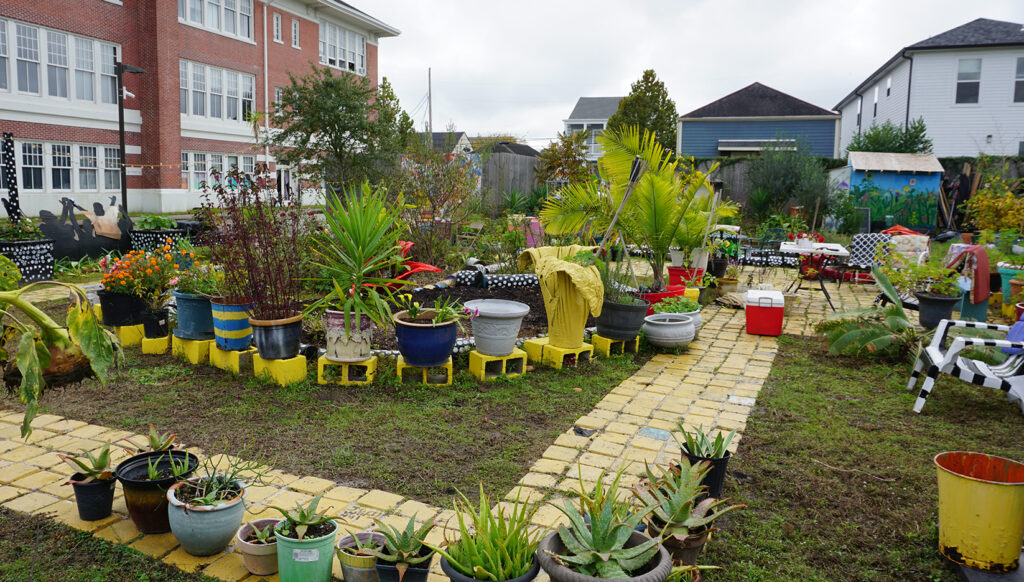
- Gloria Ward, founder of Ms. Gloria’s Garden in New Orleans
- Jason Wesaw, artis and member of the Pokagon Band of Potawatomi
Sustaining Their Ambitions
As the HILL grant concluded, the project left behind more than memories and connections. It also culminated in a comprehensive website at pblh.kzoo.edu.

“This site has curated and will house the work of the grant,” Mills said. “On it, you will hear from faculty and students. The site also notes and amplifies the missions and efforts of our partners. Finally, it provides resources for those in the humanities outside of K who wish to develop place-based learning.”
The relationships built through HILL persist and continue to evolve. Kelly, for example, looks forward to accompanying more students to places where they can experience public art as she welcomes more K students to New Orleans, where they might work on their Senior Integrated Projects (SIPs). Wesaw hopes to expand awareness of Potawatomi culture at K and throughout Kalamazoo by continuing his work with Fong and Agosa, noting that three connected but separate Potawatomi tribes are in the area.
Mills sees the conference as reaffirming an essential truth.
“So much can come of relationships nurtured over time and with respect and humility,” he said. “We hope to find ways to sustain the vision of the grant—and its most transformative initiatives with partners—by finding the resources to integrate this place-based learning curriculum within College programming.”
A Model for the Future
The HILL project demonstrated something increasingly urgent in higher education: humanities education should be both intellectually rigorous and directly relevant to addressing social inequities.
Mills said their work helped reinvigorate and reimagine experiential education at K within the broadly defined humanities. Salinas said the HILL curriculum used the existing College infrastructure, identifying key pillars of the K-Plan as its foundation, while emphasizing its mission and its values as an institution. Villegas believes the project showcased the value of a multisite education.
“We already know the tremendous value of study abroad for our students,” Villegas said. “Short-term site-based learning projects like HILL allow our students to see commonalities across the country so that they may develop more nuanced understandings of the national space.”
This HILL project is one of the reasons why I love K so much. Coming in as a first-year and already having this experience is unique. You can learn all you want, you can do your research, but once you’re in the environment, it’s a whole different experience. It’s so much more eye-opening to know that this is real.”
—Victoria Gutierrez ’28
The project also helped students develop what Mills describes as a sense of learning that comes from absorbing the sensory dimensions of a site and interacting with those who have walked the walk in relation to its histories and challenges.
“Now, I think, they can see that the other side or end of theory are people and places that demand their fullest intellectual, imaginative and emotional engagements,” Mills said. “I think that they would say they owe the people and place that commitment.”
The Mellon Foundation entrusted K with significant resources to develop models for the humanities that foster students’ investment in the discipline through its eye on social justice concerns. The HILL project proved that such models not only work, they’re essential.
“I think we need to take this project on the road,” Mills said. “Conference participants were saying that our model has potential to contribute much to ameliorating the embattled landscape of America.”
And in San Diego, New Orleans, St. Louis and Kalamazoo, seeds have been planted in students, in communities, and in the ongoing work of building more just societies thanks to HILL. The original project may have concluded, but its vision of ethical, place-based humanities education continues to take root by bringing people together.
“So many of our partners mentioned how wonderful it was to see the scope and breadth of our curriculum, to hear more about our instructional model, to learn more about our partners in other cities, and to connect with other organizations and individuals,” Salinas said of the concluding conference. “One highlight included Ben Looker and Jamala Rogers, both from St. Louis, who met one another for the first time in a K van, and during their discussion, they realized that they had been circling one another for years but had never met. As Ben said, ‘it took a van ride in Kalamazoo to bring us together.’”

