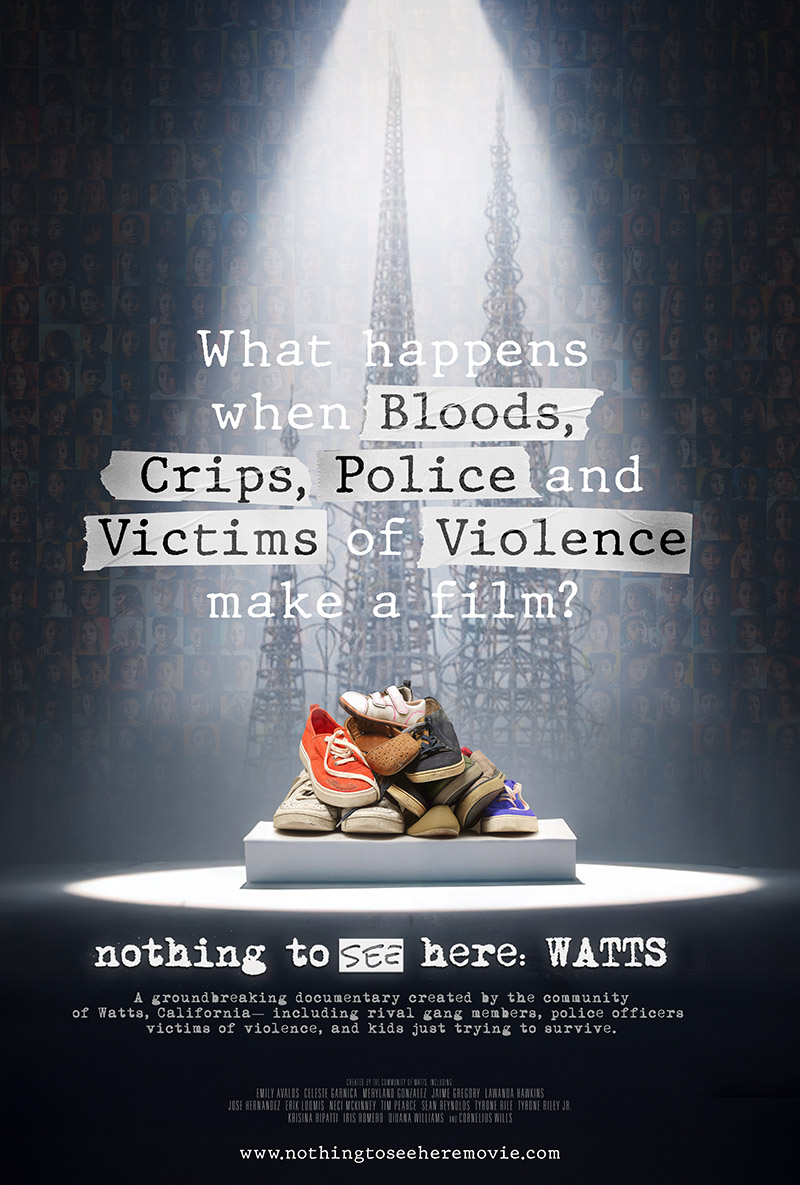
A turning point occurs almost 75 minutes into the 90-minute documentary Nothing to See Here: Watts. In a meta moment, the filmmakers include a discussion that follows the screening of their first rough cut.
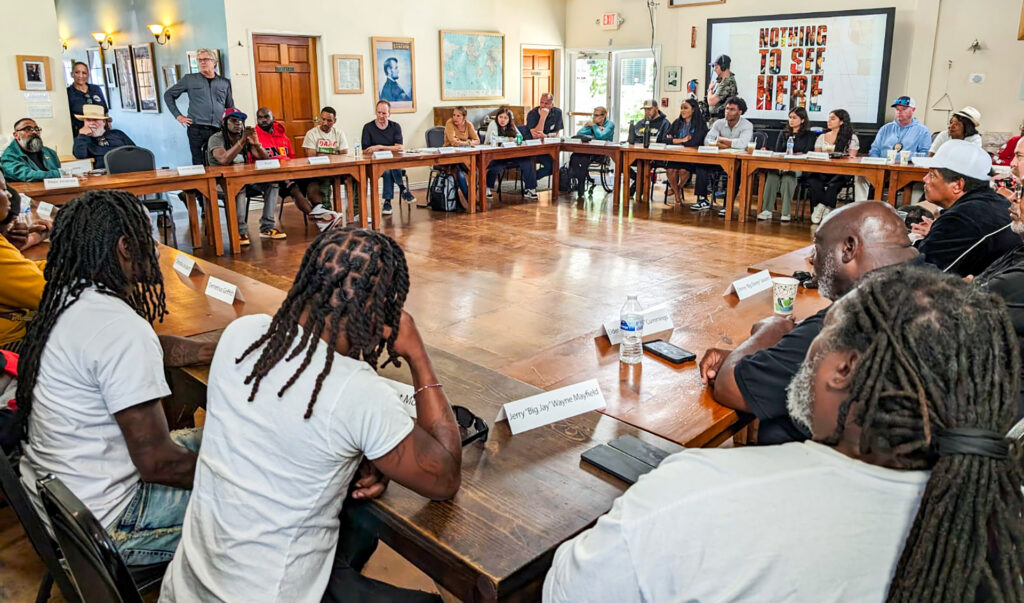
The camera pans around a square of folding tables littered with name cards, glasses of water, cups of coffee, and cans of soda. Hunched over, shoulders up around ears, hands folded on the tables, the people attending this screening marinate in tension. Just getting them all through the door took two hours, many of them believing this was a setup that would result in their arrest—or worse.
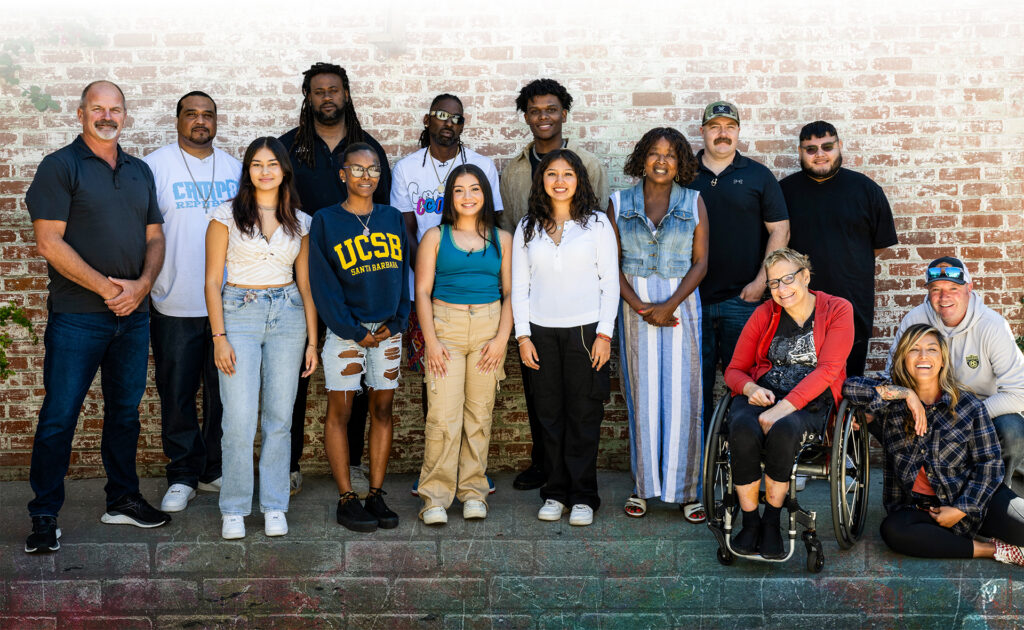
Around this table sat leaders of four rival gangs—sworn enemies with long, bloody histories and a combined 200 years spent in prison—meeting together for the first time in more than 30 years. They were joined by the documentary’s filmmakers: gang members, police officers, students, community organizers and victims of violent crime, all residents of Watts, a small, densely populated Los Angeles neighborhood known for the Watts riots and long marked by high rates of crime.
While many feared for their own safety, one thing was certain: nobody understood the impact of what was about to unfold.
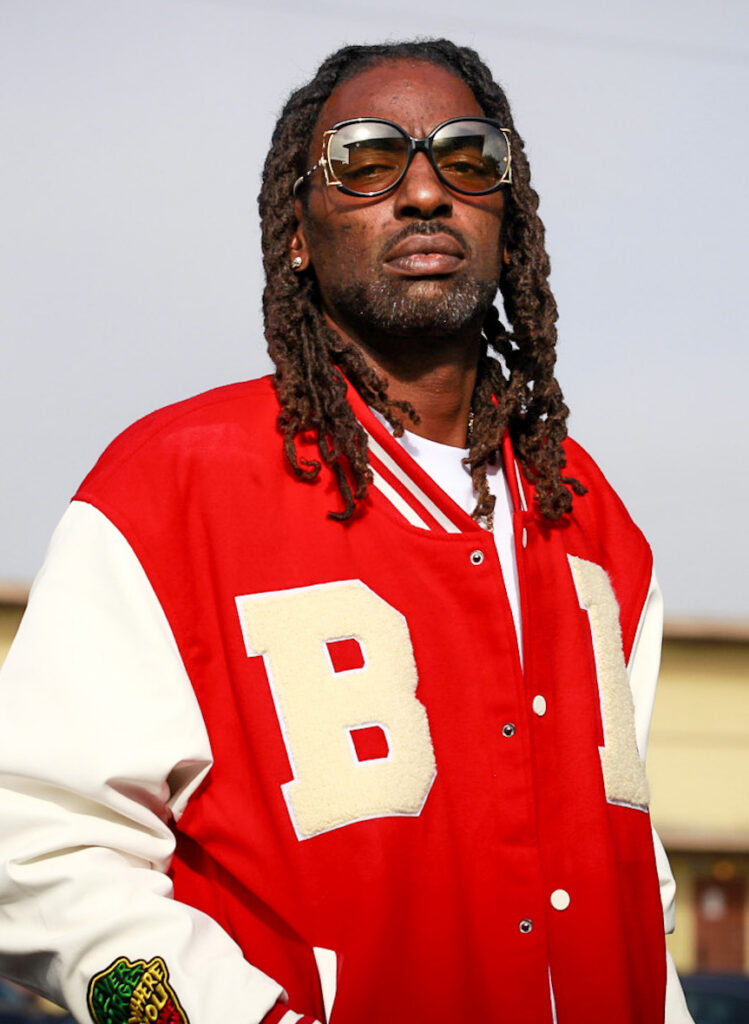
“There’s good people here; there’s good people everywhere. But this environment will bring the worst out in you if you ain’t strong.”
Cornelius Wills, gang member, Bounty Hunter Bloods
Two years before that screening, Michael Soenen ’92 had no thought of ever making a film. He was a volunteer with the Healthy Room Project, a nonprofit that transforms children’s bedrooms in vulnerable communities. Through that organization, he was offered a ride-along with the police in Watts. On that ride-along, he saw three people get shot; one person was killed, and none of it made the news. He heard from a young man whose mom put him in a gang when he was 8 years old, as the gang offered protection for him while she worked. He learned that kids in Watts were taught not to call 911 because the practice of recording and releasing 911 calls (a well-intentioned effort to equalize response times in poor communities) labeled the caller a snitch and often resulted in retaliation.
What he witnessed and heard forced a reckoning between how much he thought he knew and how much he had misunderstood.
“I’m well-read, I have access to resources, and I try to know this stuff, but I still had it so wrong,” Soenen said. “I was wondering, what else did I not know about Watts and other communities like it?”
By most measures, Soenen was an unlikely conduit for the project that would develop. Raised in Plymouth, Michigan, he earned a degree in economics with a minor in business administration at Kalamazoo College. He studied abroad in Japan, where an internship proved foundational to his future in business. After K, Soenen pursued careers in investment banking, private equity, and, eventually, venture capital. His involvement with the Aspen Institute, including his selection as a Henry Crown Fellow, deepened his sense of civic responsibility and his understanding of the role business leaders can play in addressing complex societal problems. All of these experiences would lead to an unexpected branch in his career: movie producer.
“If you had told me on graduation day that I’d one day be making a film with gang members, police officers, and students from Watts, I never would have believed you,” Soenen said. “I didn’t come to filmmaking through Hollywood at all. I came to it through curiosity. That curiosity led me down a path I never anticipated.”
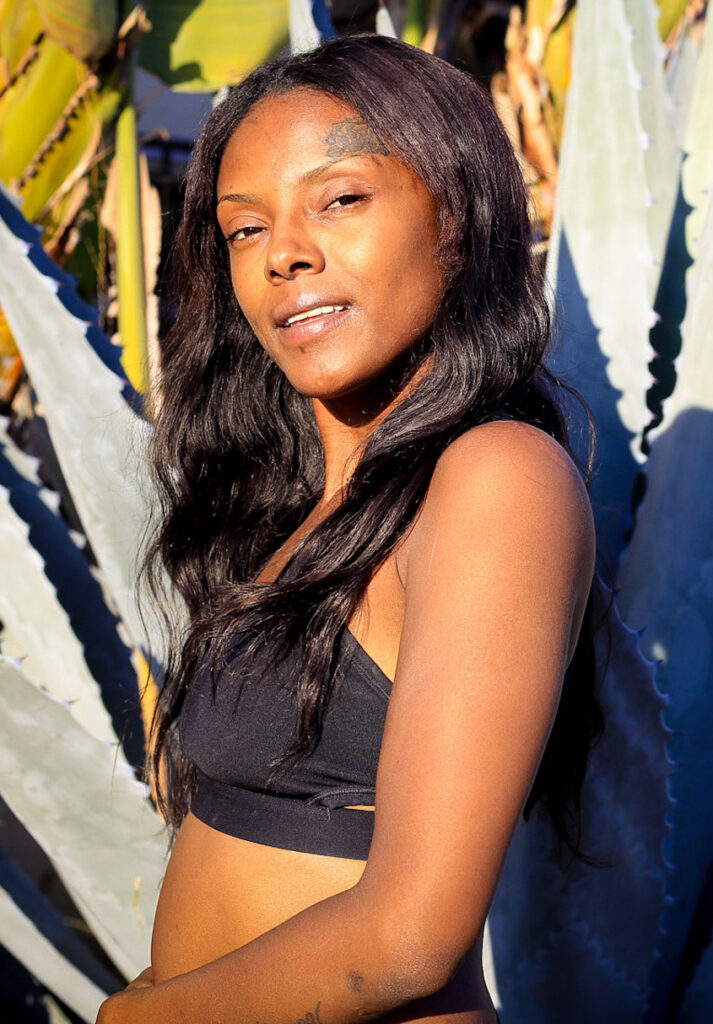
“Don’t sugarcoat it, don’t put no sugar on it. This is Watts, this is what happened to us.”
Neci McKinney, community resident
After the ride-along, fueled by the desire to learn what else he did not know, Soenen purchased 20 iPhones and set about finding people in Watts who would agree to share their lives with him.
He asked more than 200 people to film; only 20 said yes.
“I had no formal authority, no credibility, only the belief that people might share their truth if offered respect, safety and control,” Soenen said.
“People thought I was crazy; nearly everyone thought I would never see those phones again,” Soenen said. “People suspected we were setting them up. Police worried about breaking LAPD rules. Gang members worried about breaking street rules. Everyone worried that the others would twist the narrative.”
Former LAPD gang officer Tim Pearce said, “I was certain somebody was going to get hurt on this project,” and felt his role for a time was to keep Soenen from getting killed.
Instead, something incredible happened.
Over the course of the next year, fueled by the opportunity to share their story—on their terms—the 20 filmmakers created 200 hours of the most raw and honest footage Soenen had ever seen.
“The stories were riveting,” he said. “They revealed nearly every perspective of the community. You could see every person’s point of view with a new perspective.”
With the desire to share their work with others outside the community, Soenen gathered the group together and shared a novel idea, never before tried in film. If they would like to turn their work into a documentary, he would build the infrastructure for them, if they would serve as the filmmakers. There would be one rule: All 20 filmmakers had to agree on the final cut.
To many, the idea seemed impossible. The filmmakers were longtime enemies. Participants included Lawanda Hawkins, a community activist whose son was murdered by one of the gangs working on the project; Sean Reynolds, a student who was shot in Watts by the Crips, who were also filming on the project; Neci McKinney, a single mother who survived an assault and robbery during filming by the Bounty Hunter Bloods; Cornelius Wills, a member of the Bounty Hunter Bloods whose gang had been responsible for the crimes committed against Neci and others in the film; Tim Pearce, a former Los Angeles Police Department (LAPD) gang officer who had put gang injunctions on many in the film; and his partner, Kristina Ripatti, a former LAPD officer who was shot and paralyzed in the line of duty; along with several children from Watts, including Meryland Gonzalez, a student and Olympic boxing hopeful, among others.
Over the next year, they met numerous times to watch each other’s stories as a group and make the decisions needed to create the film. Through this process, dialogue happened. They debated what to include and what to cut, whether they were reinforcing stereotypes or honoring truth. They shared, argued, and took accountability. And as each saw the vulnerability and evidence of the other’s humanity on the screen, empathy slowly began to unite the group.
Those discussions became the unexpected anchor of the film. The filmmakers didn’t forgive or forget. They didn’t seek or find absolution. They didn’t resolve the past. But through the filmmaking process, they found they shared a common goal: they wanted a better future for their children.
“In a sense, it became a mini truth and reconciliation process,” Soenen said. “Rather than do it in court, they did it through filmmaking. Along the way, they came to this realization: Everyone had lost: the police, the gangs, the victims, and most importantly, the kids. A lot of what happened, no one was ever going to forgive, but they could all agree they wanted something better for their kids.”

“Maybe this film could be a vehicle to where they could kind of say, hey, you know, we all want things to be a little bit better. Maybe this changes a couple of minds. It’s not going to everything, but its gotta start somewhere, and maybe this helps turn the knob just a little more toward less violence.”
Tim Pearce, former police officer
After two years of work, the filmmakers agreed to a final cut. And this created a new obstacle, Soenen said: “Now, without any experience, we had to find a way for the film to be seen.”
The filmmakers, caring less about film festivals and more about their community, proposed something radical: Hosting a screening for gang leaders. After intense debate, including one filmmaker resigning from the project, the group decided to move forward with the idea.
The screening took more than six months to organize, navigating numerous safety and legal concerns. Ultimately, the film was shown in a former warehouse to the most active gang members. Afterward, participants asked for more screenings throughout the community. Those events followed, many in gang houses, each with its own security and risk. Following each screening, the same message came through loud and clear: We would give this all up for our kids.
Conversations then followed: What would that look like? What resources will we need to make that happen? Over the next several months, discussions of a peace pledge emerged—effectively a new set of street rules. This pledge crystallized around two core concepts.
First, no retaliation between gangs. If someone caused harm to another gang, the gang responsible would handle the discipline internally, rather than follow the long-standing practice of retaliatory violence. It was a shift that required all gangs to simultaneously change their behavior, putting leaders at risk of appearing weak to rivals and to their own members. In the context of gang violence, however, this promise was critical. Retaliation, Soenen explained, is often what turns a chaotic incident into a homicide.
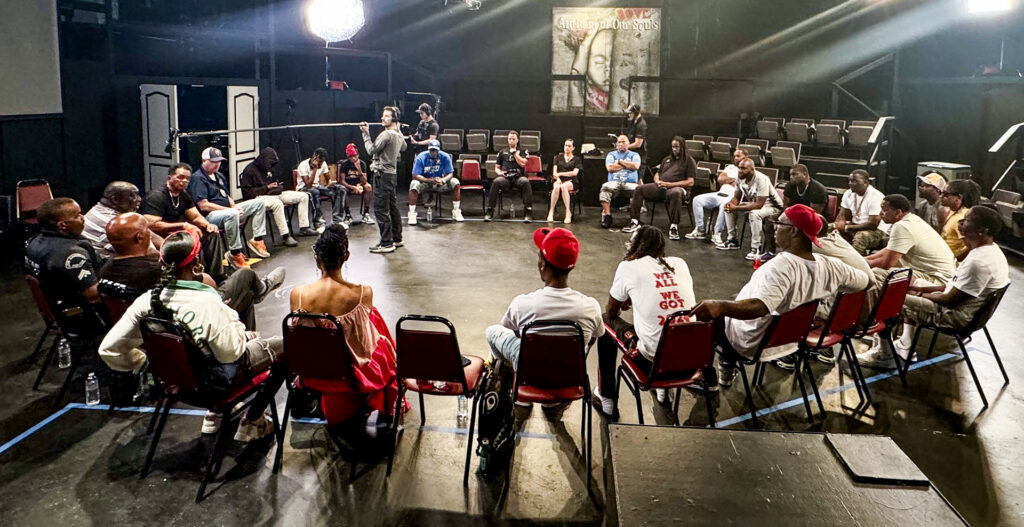
Second, the gangs pledged no violence against women and children. If a member crossed that line, the gangs would break with generations of precedent to work with the police and get the violator turned in. “That was a friction point, and they’ve stuck to it in a big way,” Soenen said.
This community-wide effort, including LAPD, gangs, nonprofits, education, political leaders, and others, has brought about staggering results.
“During our three years of filming, more than 100 community members were killed,” Soenen said. “In the 12 months following the community screenings and the subsequent peace agreement, there were zero homicides in Watts’ four major housing projects. This decline did not come from new policies or legislation; it came from people who had been enemies for decades, getting in the same room together, seeing each other’s humanity, and deciding to work together to change the future.”
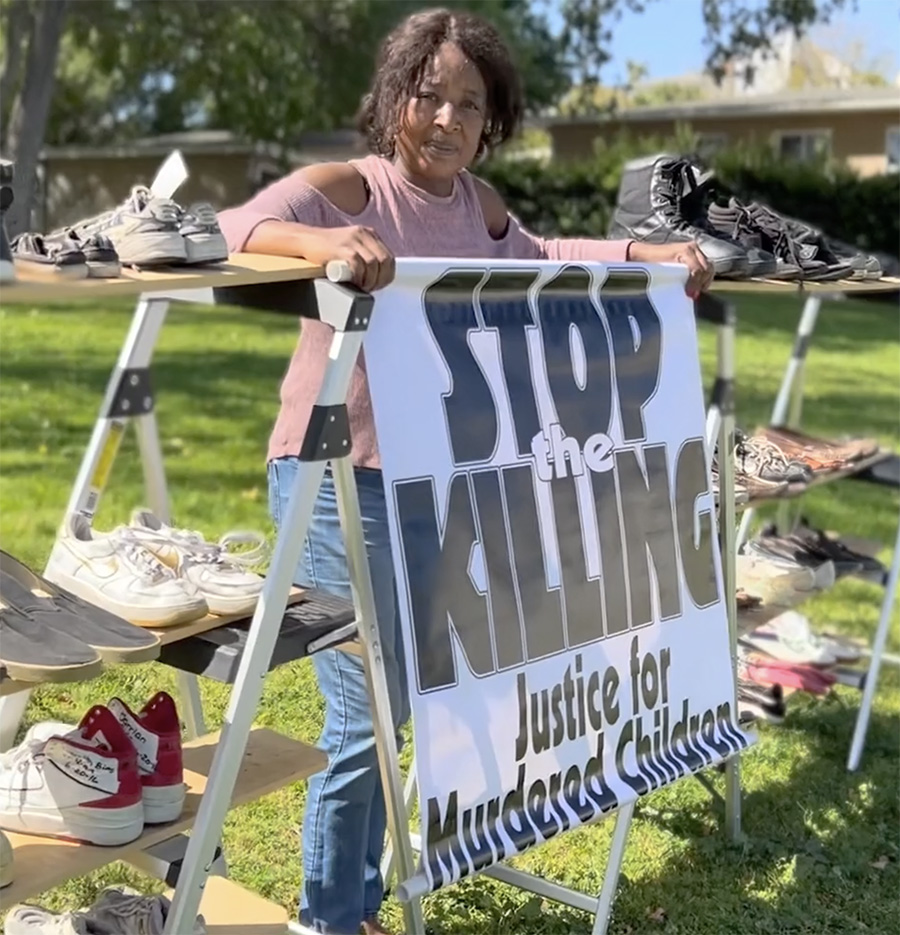
“They’re seeing my heart, and I don’t know how people are gonna react to that.”
Lawanda Hawkins, community activist
Parts of the film are difficult to watch. Violence, loss, grief, anger, racism—these things make us uncomfortable.
“Because those living the story made the choices, the film takes on some extremely difficult issues that are not often socially acceptable to talk about,” Soenen said. “When dealing with sensitive matters, I treated them like they were CEO’s. I would ask, ‘Have you thought about this? Maybe you should consider that, but ultimately these are your decisions to make.’ There were scenes I would have included, others I would have excluded, and in the end, the choices they made contributed to meaningful change in their community.”
At times, Soenen was certain that disagreements spelled the end of the project. At times, staying out of the way proved painfully challenging.
“This effort required a different kind of courage than I expected,” Soenen said. “I had to earn the trust of individuals who had every reason not to trust outsiders. There were moments the project nearly collapsed—when participants refused to enter the room, when safety concerns felt immediate. But for the filmmakers to ‘own’ the film, I had to be irrelevant to the story. My role was to be the infrastructure—nothing more.”
Stepping back allowed others to step up, sometimes in startling ways.
“Some filmmakers who had been victims of crime requested their own case files from the LAPD and put them in the film, which they had no authorization to do,” Soenen said. “LAPD was like, ‘No [expletive] way, this will incite gang violence and cause more problems.’”
After months of lobbying, Soenen accepted that LAPD wouldn’t approve the material. When he shared the news with the filmmakers, the gangs were like, “Let us try.”
“Imagine gangs calling the police to put their own crimes in the film?” Soenen said. “In the end, their efforts led to these critical scenes being included.”
The film’s title serves as a constant reminder to Soenen of his own blind spots and the importance of a community telling its own story. It calls back to when Soenen, newly moved to LA, took an Uber to a Lakers game with a helpful driver who pointed out landmarks: the new football stadium, the university. As they drove by Watts, Soenen asked what area they were in.
The driver’s response? “There’s nothing to see here.”
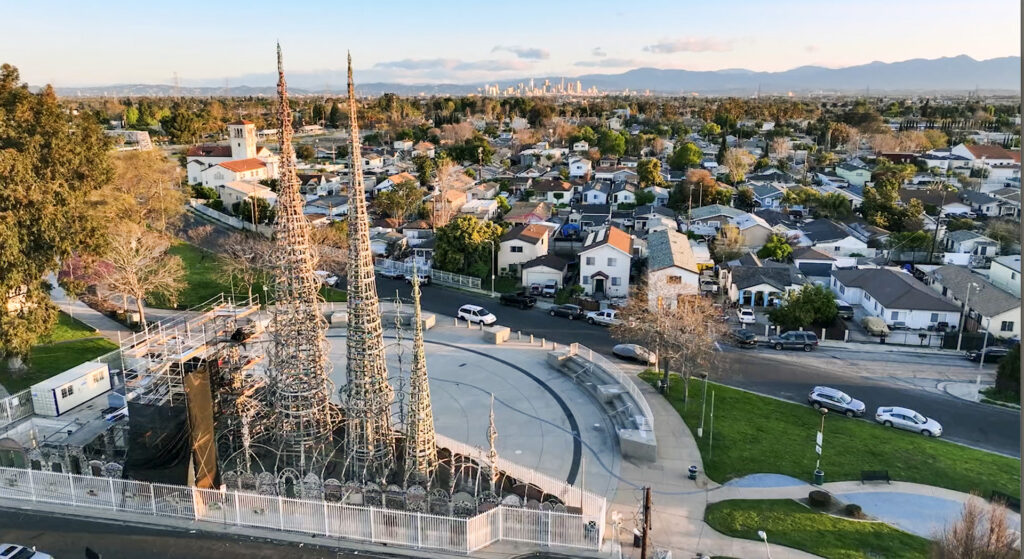
“And I believed him,” Soenen said. “The title is ultimately a jab at me. If all it took was an Uber driver to convince me I did not need to look further, what else was I overlooking?
“This work changed me. I sat in rooms where community members revealed their most painful experiences. I learned when to step forward and when to step back. I watched rival gang leaders and the top gang officers in Watts develop empathy for one another, to work together—something they themselves had believed impossible,” Soenen said.
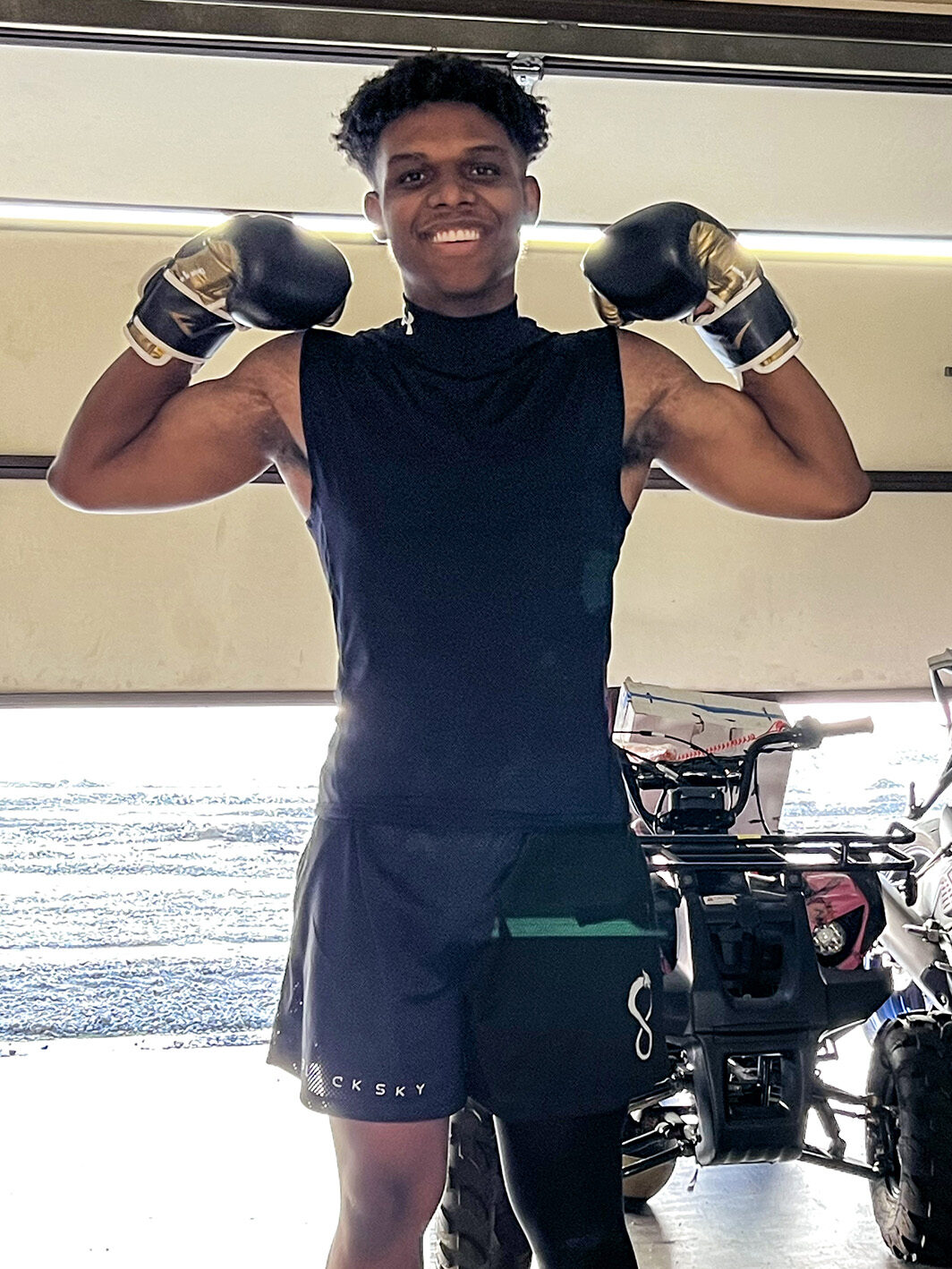
“It has to start somewhere, and it starts with small differences, small changes.”
Sean Reynolds, student
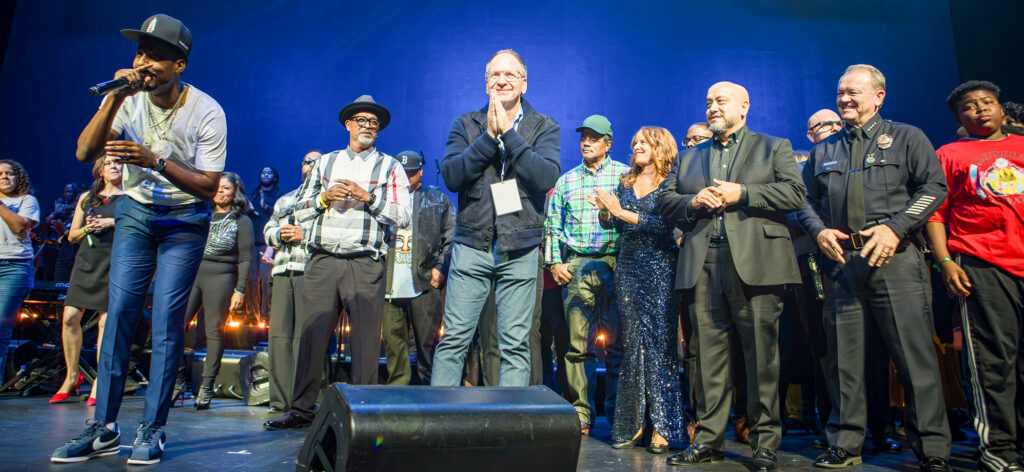
A sold-out premiere at the Peacock Theater in Los Angeles drew 4,000 people, including representatives from eight gangs, community leaders, more than 200 LAPD officers, including the chief of police, and more than 50 nonprofits. All 300 contributors to the film took the stage together for the finale.
Outside of Watts, audiences are taking note of the changes in the community and the universal lessons learned.
At the Aspen Ideas Festival, the film’s trailer and a panel featuring filmmakers challenged attendees to rethink their preconceived notions about division and what it takes to work together. “We had leaders from the Bloods and the Crips, and the kids, and the top gang officer, and people were like, ‘How are all these people on the same stage?’” Soenen said. “The core message is, if we can do it, if we can choose to work together, are you so sure you can’t as well?
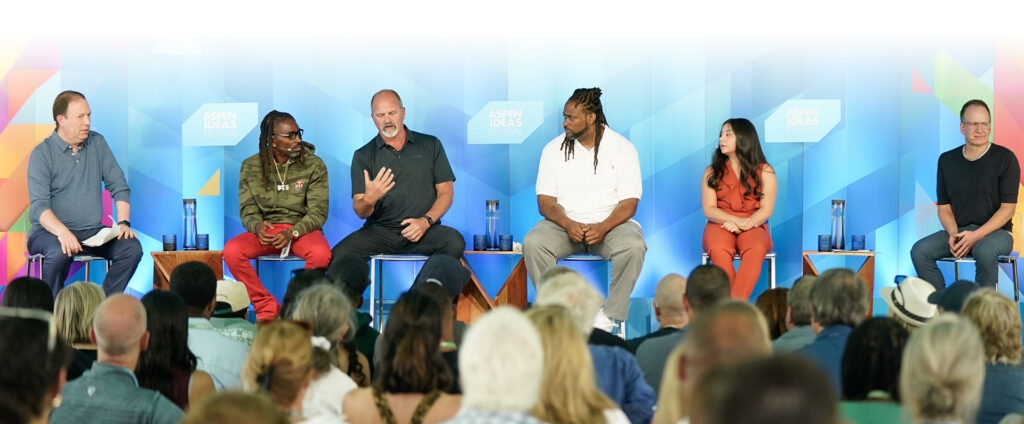
Tim Pearce, Tyrone Riley Sr., Emily Avalos and Michael Soenen ’92 at the Aspen Ideas Festival.
“Lawanda Hawkins says, ‘I will never forgive them for murdering my son, ever, but I will work with them so the next kid doesn’t need to get murdered.’ It was a mic drop moment in the room, because the audience is full of people who are supposed to have all the answers, and here are the gang members, police officers, victims of violence—with the least resources, least access to education and most reason to hate the other—demonstrating leadership and delivering results that are the complete counter-narrative to the ‘we are so impossibly divided’ narrative that exists in some places.”
The documentary recently screened at the King Center in Atlanta for Dr. Martin Luther King Jr.’s birthday and has screenings scheduled at numerous other locations, including Harvard University, which is considering a case study on the film. In addition, the film has been featured in Forbes and has won numerous awards from the Cannes World Film Festival, Indie Fest Film Festival, Accolade Global Film Competition, and the London Independent Film Awards, among others.
Groups from New York, Chicago, Detroit, and several other cities are requesting that the project be replicated in their cities. Another group wants to give phones to inmates being released from prison and invite them to tell their firsthand stories of what it takes to reintegrate into society.
“The possibilities to apply the concept to other topics are endless,” Soenen said. “What else might we learn when we take out the storyteller and let people tell their own stories, on their terms? Are we ready for the uncomfortable truths that might emerge? How do we scale the good that can come from this?”

“You gotta believe in them. You show somebody you believe in them and everything else will come in.”
Tyrone Riley Sr., basketball coach, former gang member of Grape Street Crips
As the film and soundtrack prepare for a 2026 rollout, Soenen is most proud of the leadership the community has shown and its continued efforts to build on the progress they have made.
“They built a choir of kids who could never cross gang lines before. That choir now sings with Grammy artists,” Soenen said. “Tyrone Riley built a basketball team with athletes from all four housing projects, people who could never speak to each other in the past. That team finished second in the city championship.
“From my perspective, seeing the results—kids no longer being killed—is keeping everyone moving forward. It feels like they have hit this tipping point; they have pride, their kids have hope, and they are moving forward every day.”
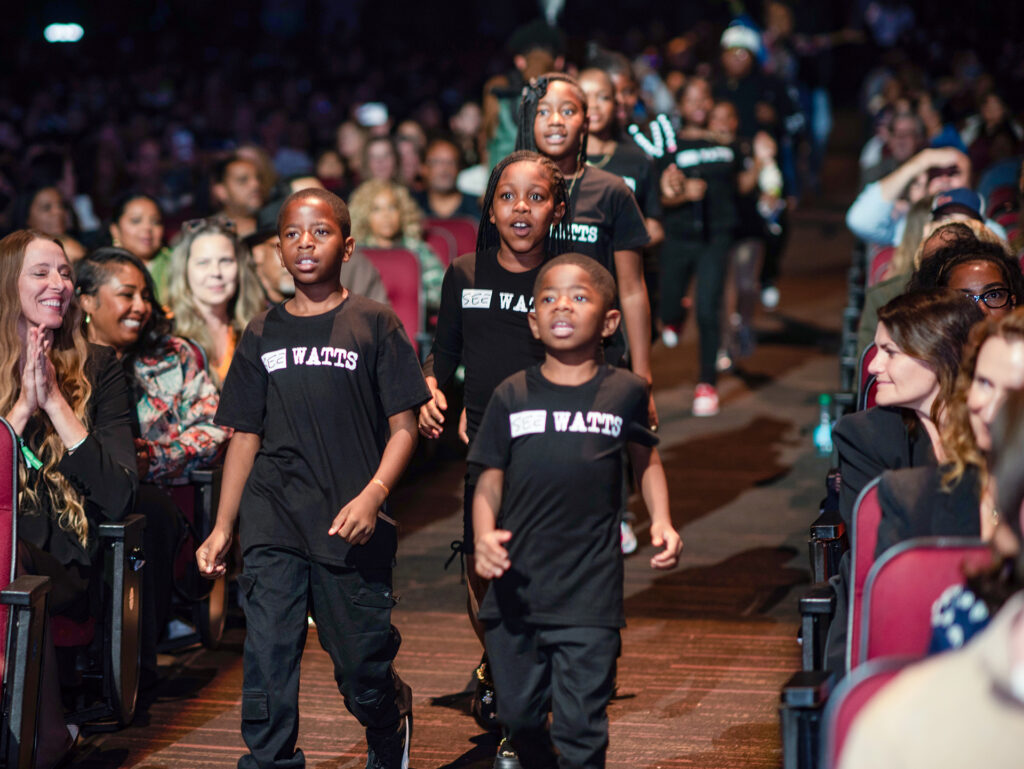
Proceeds from the film and its accompanying soundtrack (which includes a slate of artists with more than 85 Grammy nominations between them and the Watt’s Roc Kids Choir) go to the Nothing to See Here: Foundation, led by the filmmakers in the documentary. Soenen’s hope is that it becomes a mechanism that enables the community to continue investing in itself.
“My goal was to create the conditions for people to tell their own stories, to uphold their agency, and see what happened. And in this case, the incredible happened—a reminder that when people are given the tools and trust to speak in their own voice, transformation becomes possible—for all of us.”
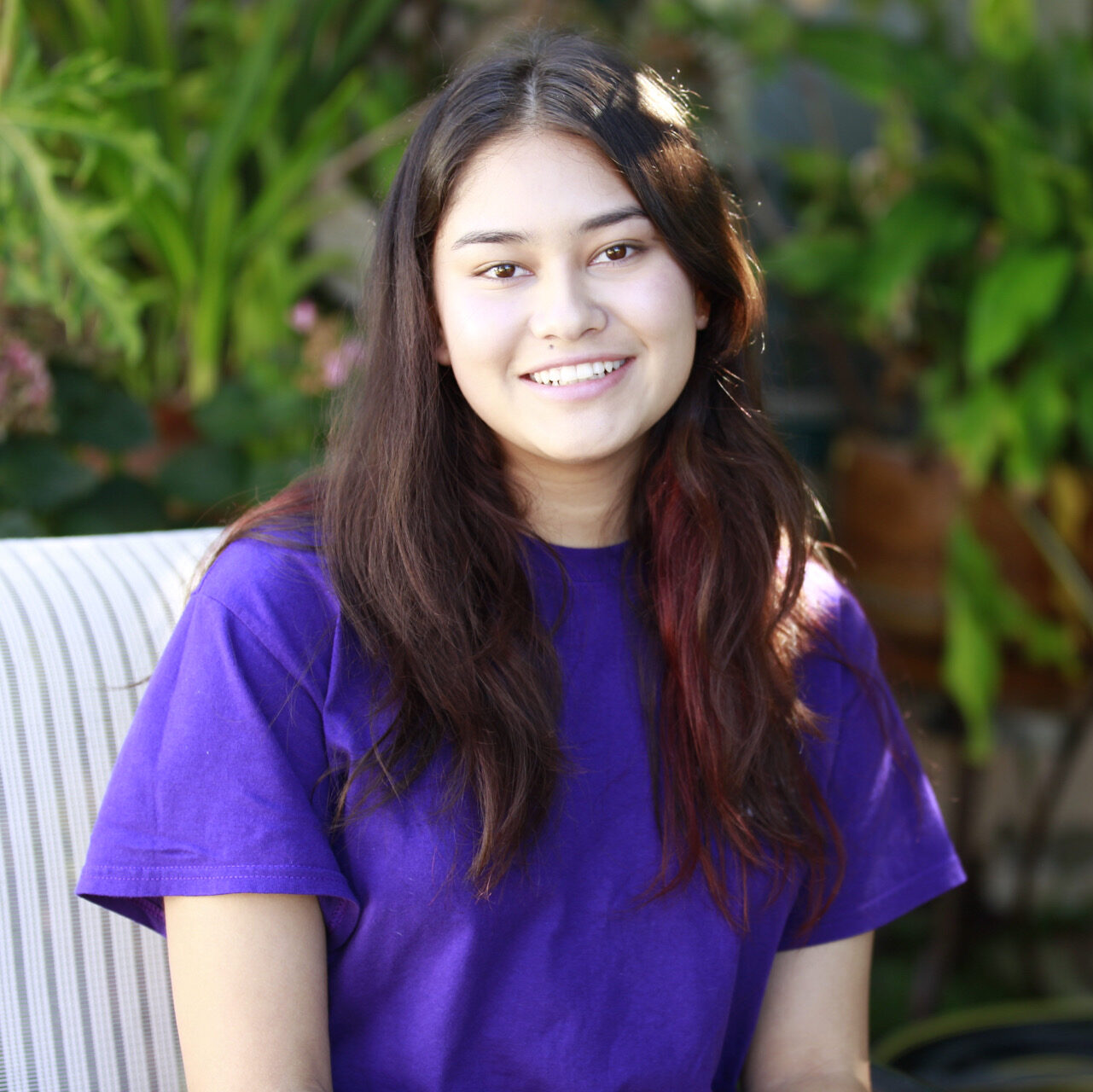
“How are we supposed to be a community if we can’t trust each other?”
Emily Avalos, student
I have this new sense of hope that our voices will be heard.
Jose Hernandez, pastor, former gang member of Watts Colonia Weigand
I never felt more fulfilled than helping people there, because they remind me of my people and they remind me of my life.
Iris Romero, homicide detective