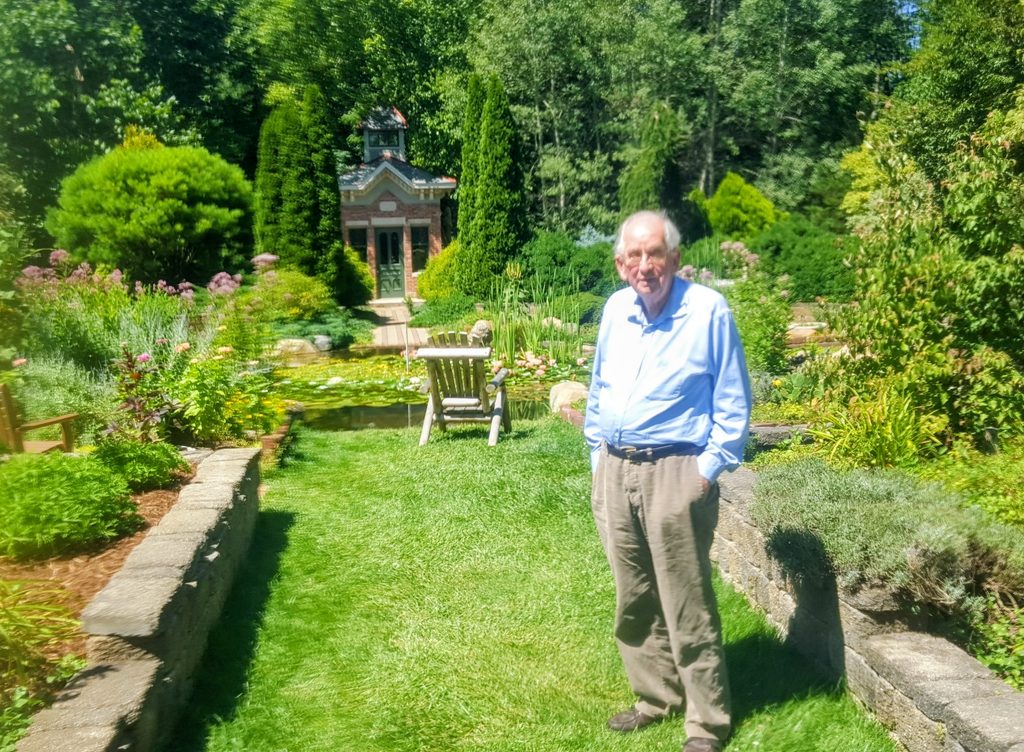
George Nielsen spent a lifetime making students feel at home—and ensured that support would outlast him.
By Fran Czuk
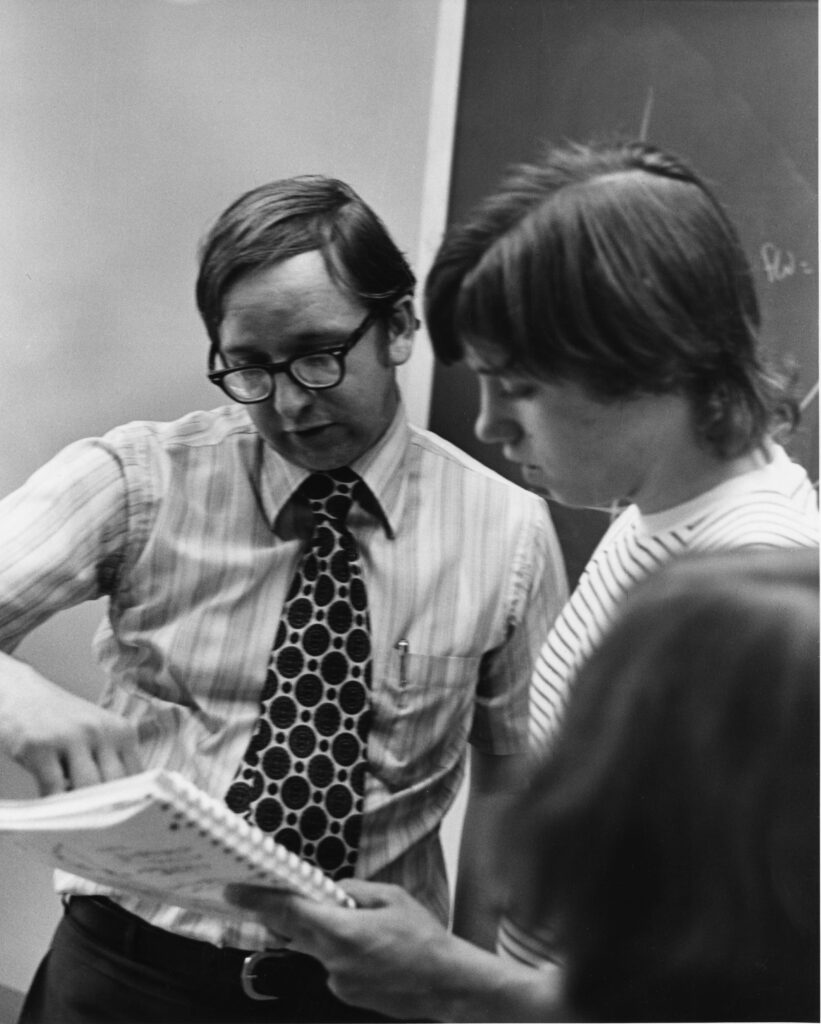
George Nielsen lived a rich, vibrant life woven deeply into the fabric of Kalamazoo College, and he took steps to ensure his support of the institution would continue past his lifetime.
A professor in the mathematics department for 36 years and advisor to international students for two decades, Nielsen left his entire estate—more than $4.5 million, built through a frugal lifestyle and savvy investments—to the College to establish a scholarship fund for degree-seeking international students.
The George M. Nielsen Scholarship is now K’s second-largest endowed scholarship and a fitting legacy for a man who invested time, care and action into helping so many international students feel at home in Kalamazoo.
The K-Plan brought a new emphasis on global perspective to Kalamazoo College in 1962, and Nielsen joined the faculty the following year. In addition to a Ph.D. in mathematics, he also brought a love of travel, pride in his Danish heritage, and a sincere interest in his students.
A quiet man who listened more than he talked, Nielsen was gracious, calm, even-tempered and humble, said Fred Jackson ’60, a close friend for 60 years. The two met at a dinner hosted by then-economics professor David Mirza and his wife, Leona, and became lifelong friends.
John Fink, professor emeritus of mathematics, echoed that assessment of Nielsen’s character, adding that as a colleague and teacher, he was “completely engaged and attentive—a rock-solid team player. When he spoke, it mattered.”
A brilliant mathematician whose dissertation work in modular Lie algebra in the early ’60s is still well-regarded, Nielsen held high standards for proper mathematics and for his students, earning their trust and loyalty, Fink said.
“This unassuming guy established some lasting theorems in mathematics, but I don’t think he would ever say that was his contribution to the world,” Fink said. “I think his contribution to the world is the students that he worked with.”
Given the opportunity to go on sabbatical early in his career, Nielsen traveled around the world by himself for several months—a trip he would talk about the rest of his life. He particularly enjoyed his time in India.
“I think that trip was an important component of the way George understood himself as a citizen of the world,” Fink said.
Several times throughout his life, Nielsen traveled to Denmark, where he explored his father’s homeland, met distant relatives, and deepened his pride in that heritage, experiences that contributed to his care for international students. His office was full of mementos from those students and from his own travels, signs of a global life despite 60 years’ residence in Kalamazoo.
“He was a completely safe person to connect with as a lonely international student,” Fink said, “and if I were an international student, I would have trusted him to take my needs seriously and to do what he could to address them.”
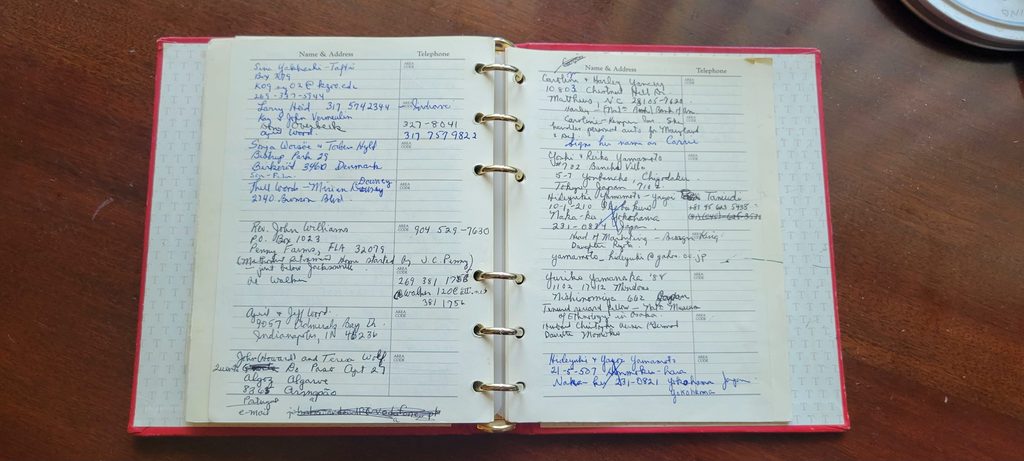
Jackson now possesses Nielsen’s address book, a testament to relationships built and maintained across years and borders. The book is full of names of students with addresses all over the world, many crossed out with a new address written underneath. In a time before email and internet searches, Nielsen kept track of students for decades, visited them when he traveled, and reconnected with them when they visited campus.
“The week George died, a Japanese student was in the States trying to get together with him, right to the end,” Jackson said. “I think George only saw the influence students had on him, and not the influence he had on students. It just wasn’t his nature to look at it that way. He did influence them. It’s obvious. They can all speak to it. But that was part of his graciousness.”
Suzie (Martin) Gonzalez ’83 recalled that Nielsen was one of the first faculty members she met at K as a student. She was considered an international student, having lived the previous 10 years in Puerto Rico.
“Dr. Nielsen was soft-spoken, but exuded incredible confidence,” Gonzalez said. “He asked about my interests, goals, and passions and helped me develop my K-Plan. He always remembered details about each of our conversations. While math was not my forte, his confidence in me convinced me to take a math class with him. He was an excellent teacher, and I learned more from him than I ever thought possible. I moved to an advisor in my major once I declared it, but he always stopped to chat and offer me encouragement through graduation.”
Outside the classroom, Nielsen engaged in campus and community life.
A pianist in addition to a mathematician, he attended many musical performances on and off campus. Jean Calloway, longtime chair of the math department, held season tickets to the Lyric Opera of Chicago, and Nielsen would often accompany him. Even in January, they would finish teaching for the day, drive to Chicago, have dinner, watch the opera, and drive back to Kalamazoo in the snow.
He loved attending K sporting events, especially college basketball.
“He and I went to a lot of basketball games over the years,” Jackson said. “Since he didn’t get frustrated very often, it always made me laugh that he would get so ticked off when it took 30 minutes to play the last two minutes with all the timeouts and the fouls and the substitutions and on and on.”
For a time, Nielsen lived in Severn Hall, where he enjoyed serving as a kind of de facto house father. He was a good cook, Jackson said, and he hosted a lot of dinner parties. At some point, however, he tired of finding and trying new recipes, and he settled on five dishes to rotate, including a goulash, shrimp scampi, beef stroganoff and a chicken dish. He also mastered an apricot Sacher torte—a Viennese dessert made of chocolate sponge and apricot filling with a rich chocolate ganache—that was “heavenly” and in high demand around campus.
A 25th anniversary recognition presented to Nielsen by Calloway in 1988 acknowledged his more-than-fair share of faculty assignments, his faithful attendance at College lectures and musical, dramatic and sporting events, his care in seeing that his students actually learned something, his tracking and celebration of alumni successes, his love of travel, and his regular participation in noon bridge games at the snack bar. The citation also honored Nielsen’s genuine interest in and concern for students, shown through exam week help sessions, notes to those absent or ill, hours of thoughtful listening, attendance at weddings, trips to Detroit to iron out visa difficulties, and notes of congratulations upon post-graduation success.
“The Nielsen ‘Hotel’ regularly welcomes former faculty, staff members, and students who return to visit the College,” the recognition said. “The Nielsen ‘Taxi’ makes frequent trips to the local airport, fetching and dispatching those who need transportation. His unrelenting dedication to service is truly the kind of glue that holds this place together.”
In 1988, students selected Nielsen as the recipient of the prestigious Frances Diebold Award in honor of his involvement with the student body. In 1995, he received the Weimer K. Hicks Award, which honors a current or retired employee of the College who has provided long-term support to the College beyond the call of duty, or who has provided excellent service in the performance of his or her job.
After retiring from K in 1999, Nielsen loved attending emeriti faculty meetings, rubbing elbows with the people he taught alongside and keeping up with College news and gossip. He continued to attend events on campus and around town. He swam at the former natatorium two or three times a week and played bridge at the Park Club regularly.
In 2004, he officially established the George M. Nielsen Endowment, to be funded by his estate at his passing–a step he didn’t speak of outside of the College’s Advancement office.
“He kept it very close,” Jackson said. “His friends didn’t know. He may have talked of a gift to the College, but when we had the celebration of life here and shared that George had left his entire estate to Kalamazoo College to support financial aid for international students, there was a gasp in the room. Afterward, everyone said that was just like George.”
Nielsen was a lifelong bachelor with no close living relatives.
“So, the College indeed was his family,” Jackson said. “From that standpoint, it’s not surprising that he gave this gift here. And it’s not surprising he gave it to international students because he saw some of them come here with not a lot of money. They couldn’t go home on vacations; they didn’t have proper clothing when they showed up for Michigan winters. He saw what they sometimes struggled with.”
Nielsen’s gift was “a remarkable surprise, yet so fitting,” Gonzalez said. When she returned to K with her husband, President Emeritus Jorge G. Gonzalez, who served from 2016-26, she delighted in reconnecting with Nielsen. “We invited him to Hodge House in 2018 and had such a wonderful time. We talked about K in the ’70s and ’80s, his love for the College, and what he was doing in retirement. He loved K and made special connections with international students. He wanted everyone to feel at home on campus.”
This unassuming guy established some lasting theorems in mathematics, but I don’t think he would ever say that was his contribution to the world. I think his contribution to the world is the students that he worked with.”
-John Fink
Nielsen died in September 2023, gracious to the end despite increasing memory loss.
“He never thought of himself as being less,” Jackson said. “He never said, ‘Why me?’ He never got upset. He’d get lost and he’d forget, but I enjoyed being with him right up to the end because he was accepting. He went very gracefully.”
The first awards from his fund were granted in 2023-24, and so far a total of 23 scholarships have helped international students thrive at K.
“This scholarship gift is an incredible investment in the potential and future of our international students,” said Becca Murphy, dean of financial aid. “It expands access for talented students from around the world, enriching K’s academic and campus community while fostering the next generation of global leaders.”
As Nielsen’s power of attorney, Jackson receives the thank-you letters written by recipients, and he said it’s clear they understand and appreciate the gift.
“The students that receive George’s scholarships get it,” Jackson said. “They would not be studying in the United States without that scholarship. They would not be studying at incredible Kalamazoo College without that gift. And they tell me in these letters that for him to understand how important it is for them to have financial aid in order to do that—how farsighted it was of him, how prescient it was for him to make that money available. They say he must have really cared for international students if he created that gift for them.”
Just like George.