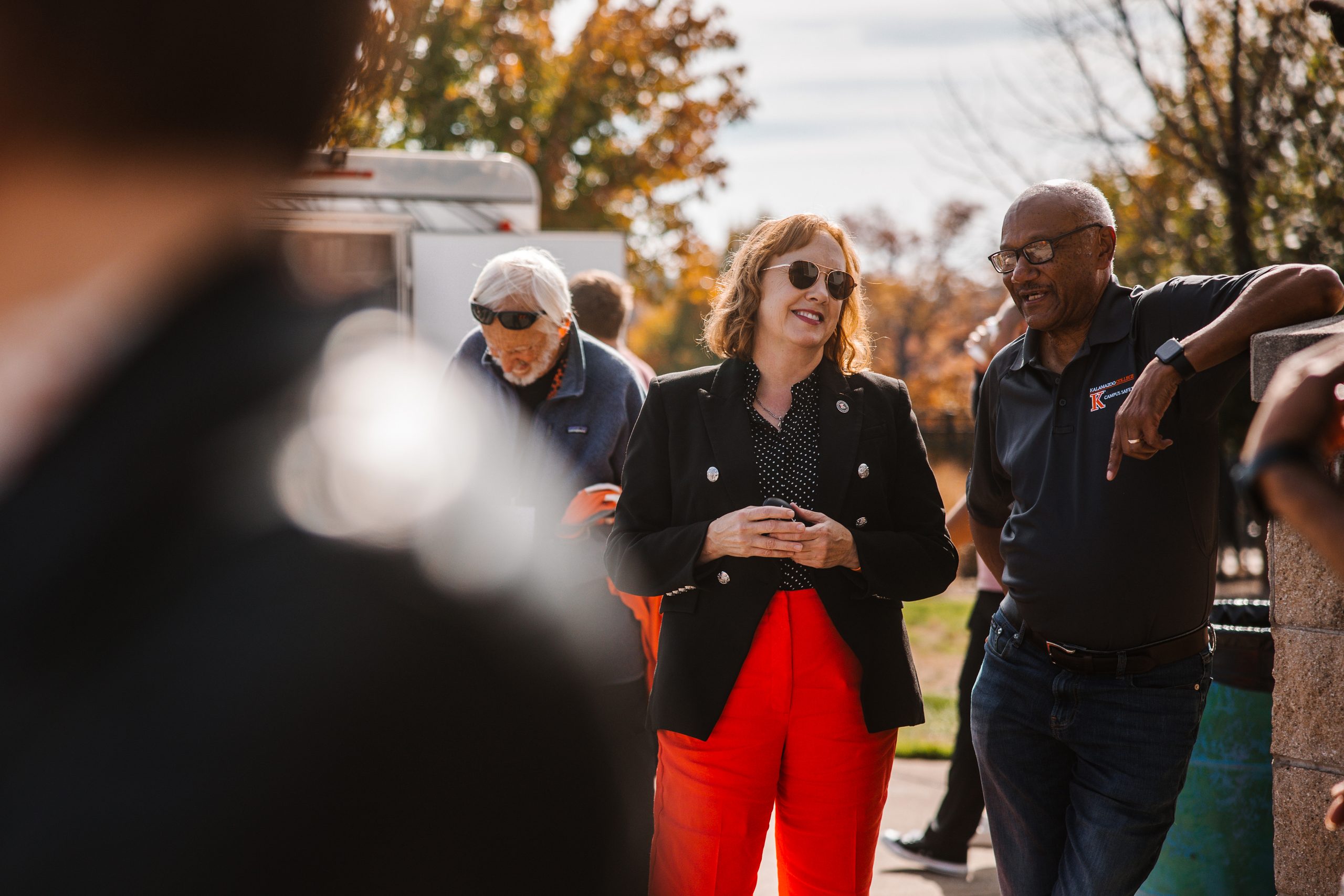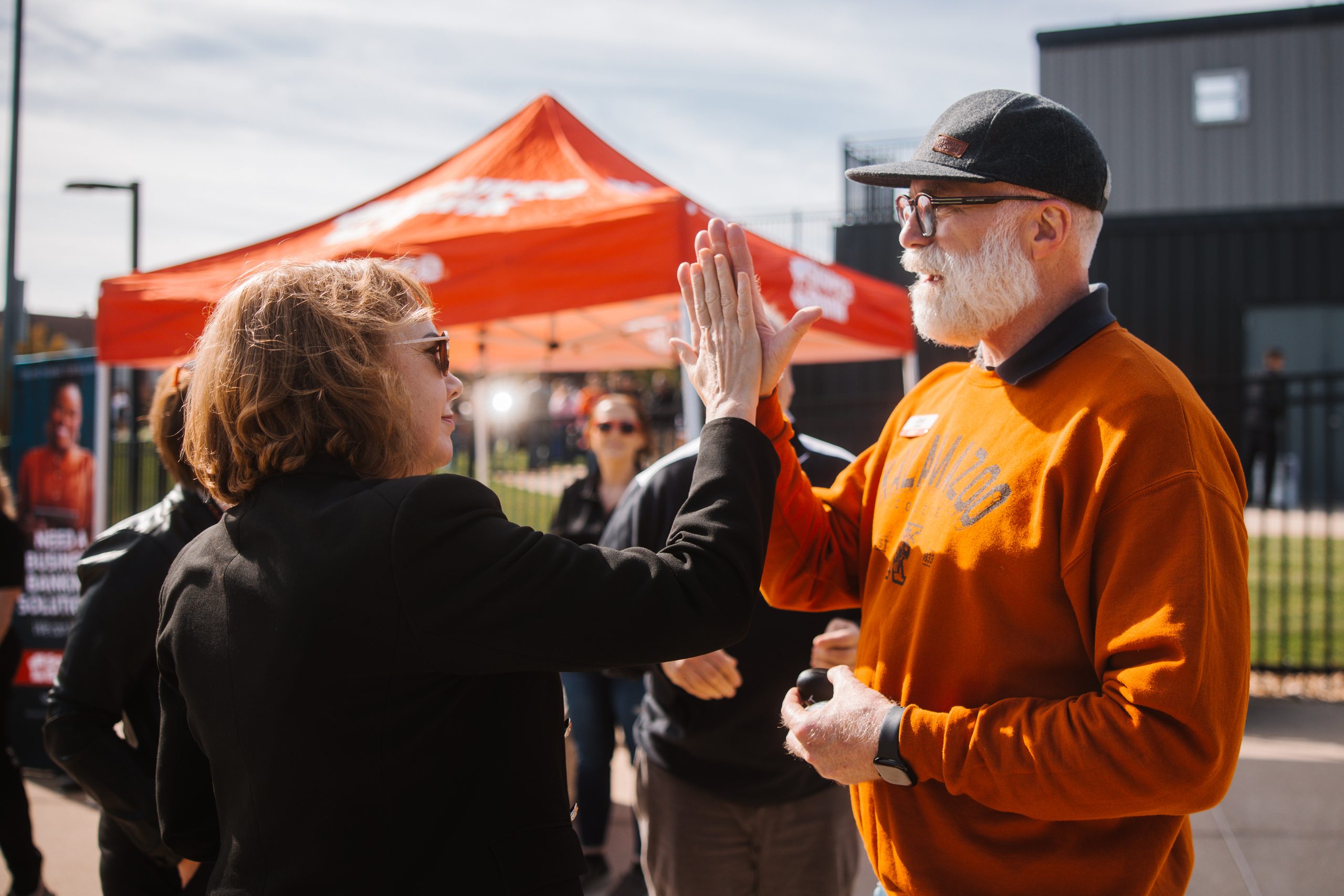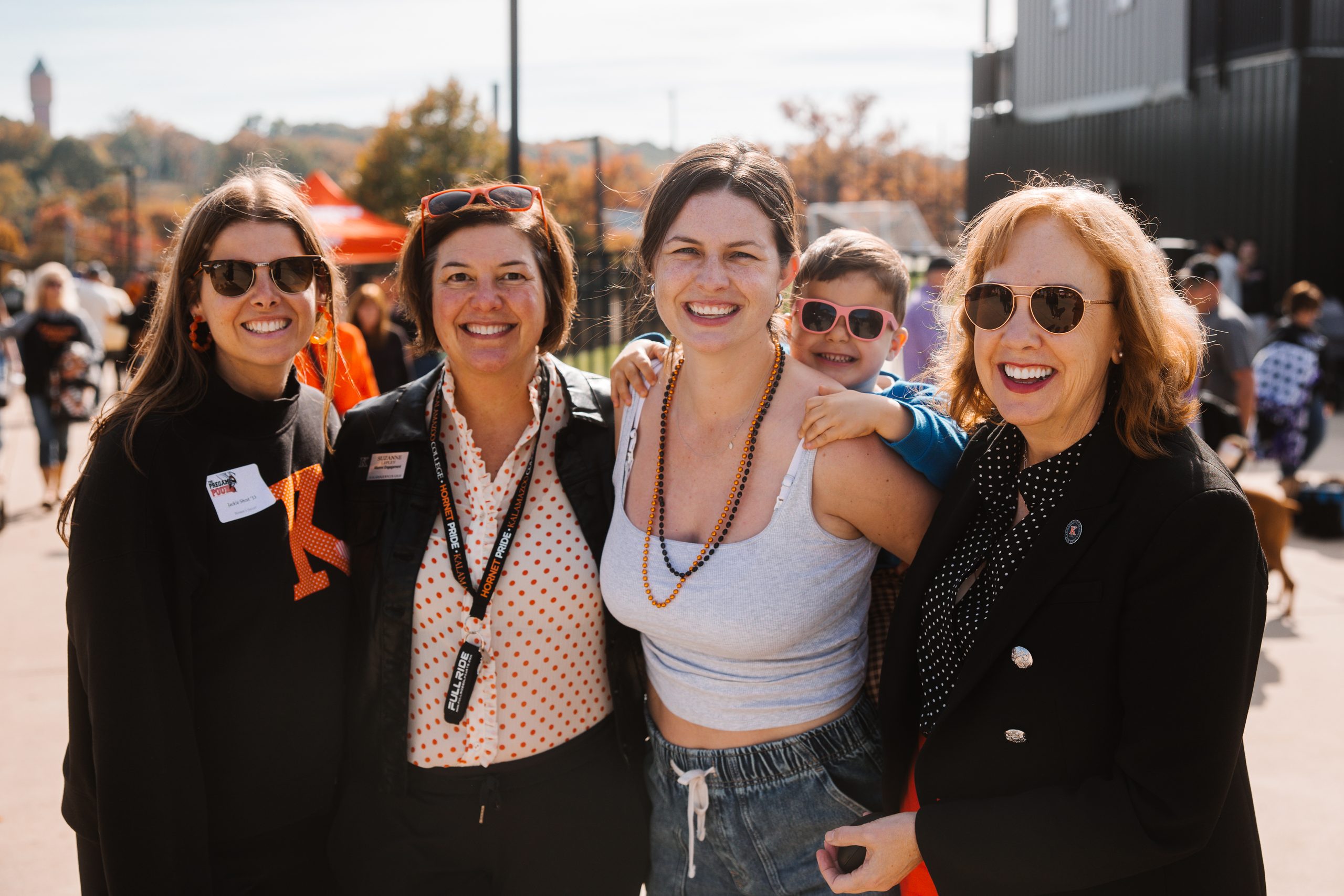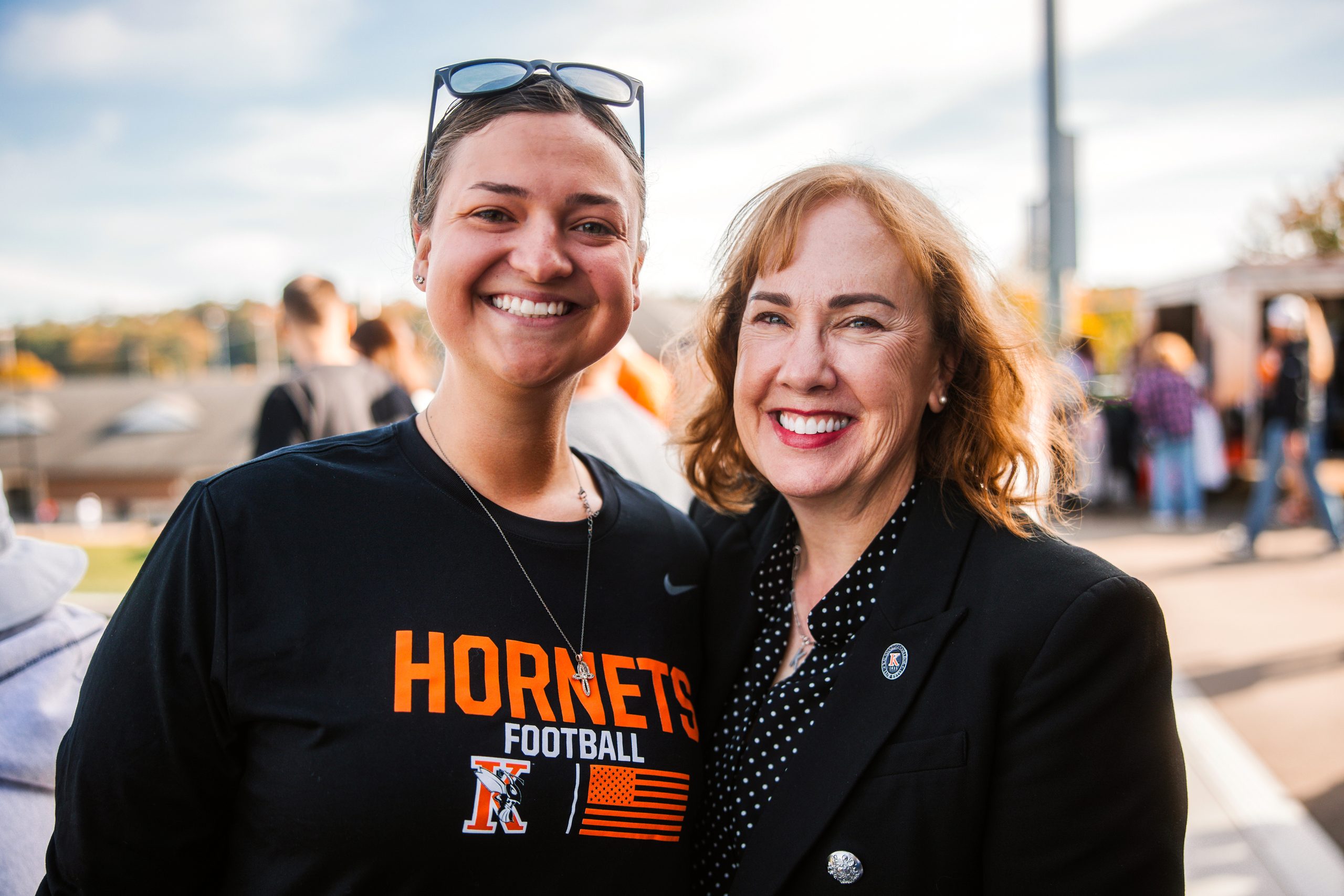
Karlyn Crowley, Kalamazoo College’s 19th president, on courage, reinvention and how curiosity leads to action.
By Sarah Frink
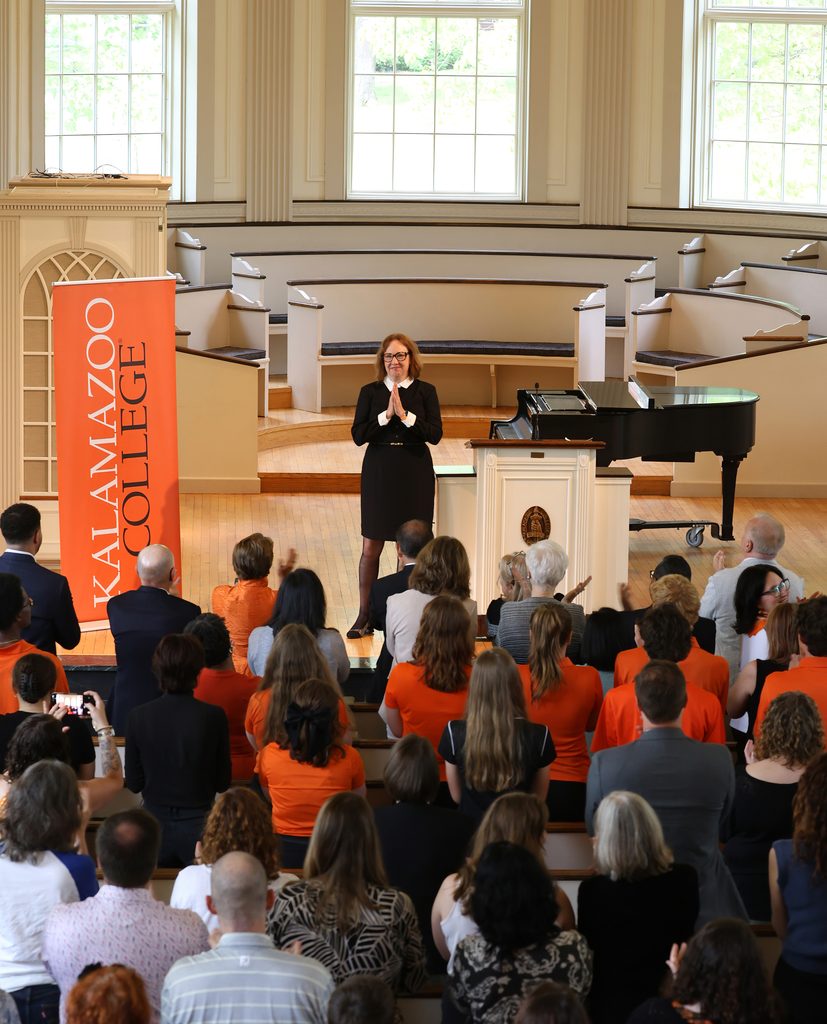
Stetson Chapel has long stood at the heart of Kalamazoo College. Rooted in K’s history, it is also where new chapters begin.
For generations, students have gathered beneath its soaring ceiling to celebrate achievements; families have filled its pews for Baccalaureates; and alumni have returned to its sanctuary to exchange wedding vows.
And on May 18, 2026, the College community gathered there to welcome Dr. Karlyn Crowley as Kalamazoo College’s 19th president.
As Crowley took the stage that morning, she gave the first glimpse of what K’s next chapter could be: bold, audacious, hopeful.
“Liberal arts is the air I breathe. And not in a nostalgic way. I believe in its core mission. I believe in its future,” she told the audience.
At the podium, she referenced Kalamazoo College’s beginnings, when Thomas Merrill arrived in the Michigan Territory with seven dollars and a daring vision to establish a Baptist college on the frontier. Over nearly two centuries, she said, the institution has continually reinvented itself—from the Michigan and Huron Institute to the creation of the K-Plan, from one generation to the next.
“Adaptation, innovation, flexibility and a kind of never-give-up-ness,” she said, “that is core to this institution.”
Those ideas are also at the heart of how Crowley leads. Her two favorite words: What if?
What Learning Could Feel Like
Ask Crowley whether there was a moment early in her life when she realized education would be central to her path, and she will smile.
“Yes—and strangely, it involved horses.”
By age 9, she had read every horse book in the local library. She volunteered at barns just to be near them. She rode competitively. At 16, she was hired to run a horseback riding school in Bloomington, Indiana.
“I’ve always believed people have an early passion that teaches them how they learn. Mine was horses,” she said. “But looking back, it wasn’t really about horses. It was about learning, teaching, entrepreneurship and community. I loved helping people discover they could do something they didn’t think they could do. I still do.”
Crowley discovered her own passion for the liberal arts as a student at Earlham College. She arrived in her Doc Martens—excited, a bit petrified—stepping into a place where ideas were debated inside the classroom and out, and wondering where she’d fit in.
“We read John Stuart Mill and Virginia Woolf and Langston Hughes,” Crowley said. “We read Thomas Jefferson’s Notes on the State of Virginia at a moment when apartheid was a prominent issue. We’d leave the classroom and then we’d go to the cafeteria and eat bowls of cereal, and we would keep talking about books…I thought, ‘This is what learning could be like? This is what learning could feel like?’
“That was the moment when I discovered that learning wasn’t just knowledge transfer…it was transformational.”
Crowley is, by her own admission, endlessly curious.
She loves bookstores and old buildings, local history and documentaries, coffee shops and questions that don’t have obvious answers. She and her family—husband John Pennington, a retired English professor, and daughter Ada, a high school sophomore—explore new places by wandering neighborhoods, visiting farmers markets, restaurants and museums, chatting with people along the way. Walking, she says, is often how she solves problems; some of her meetings happen on foot.
Curiosity, she jokes, has created half the opportunities in her life—and at least a few of the problems.
It has also shaped her approach to leadership. She loves to ask: Why do we do it this way? Does it help students flourish? What gets in the way of their success? And perhaps most importantly: What if we tried something different?
“Questions matter because they lead to action,” Crowley said. “Curiosity isn’t the destination—it’s how great institutions grow.”
A Different Model
The lesson that most profoundly shaped Crowley’s professional life began with a tragedy.
Crowley was a professor of English and women’s and gender studies at St. Norbert College in De Pere, Wisconsin. Her student, Cassandra Voss, was killed in a car accident in 2007 at 21. She was, Crowley recalled, “an extraordinary person, innovative, joyous and hopeful.”
Voss’ father, a business executive and conservative man of faith, envisioned building a center in her name—a place to promote understanding and bridge-building. Crowley helped bring that vision to life. As the Cassandra Voss Center’s founding director, she reimagined what inclusive excellence could look like at a small liberal arts college. She built partnerships with corporations—Schreiber Foods, Humana Insurance and the Green Bay Packers—as well as scholars and community leaders, creating spaces where people with different experiences and viewpoints could come together, engage in dialogue and feel that they belonged.
Looking back, Crowley says the experience transformed her understanding of leadership.
“Some of the most important work happens when people choose to build something together despite pain, difference or disagreement,” she said.
It also set a pattern. Throughout her career, Crowley has been less interested in managing existing systems than designing better ones.
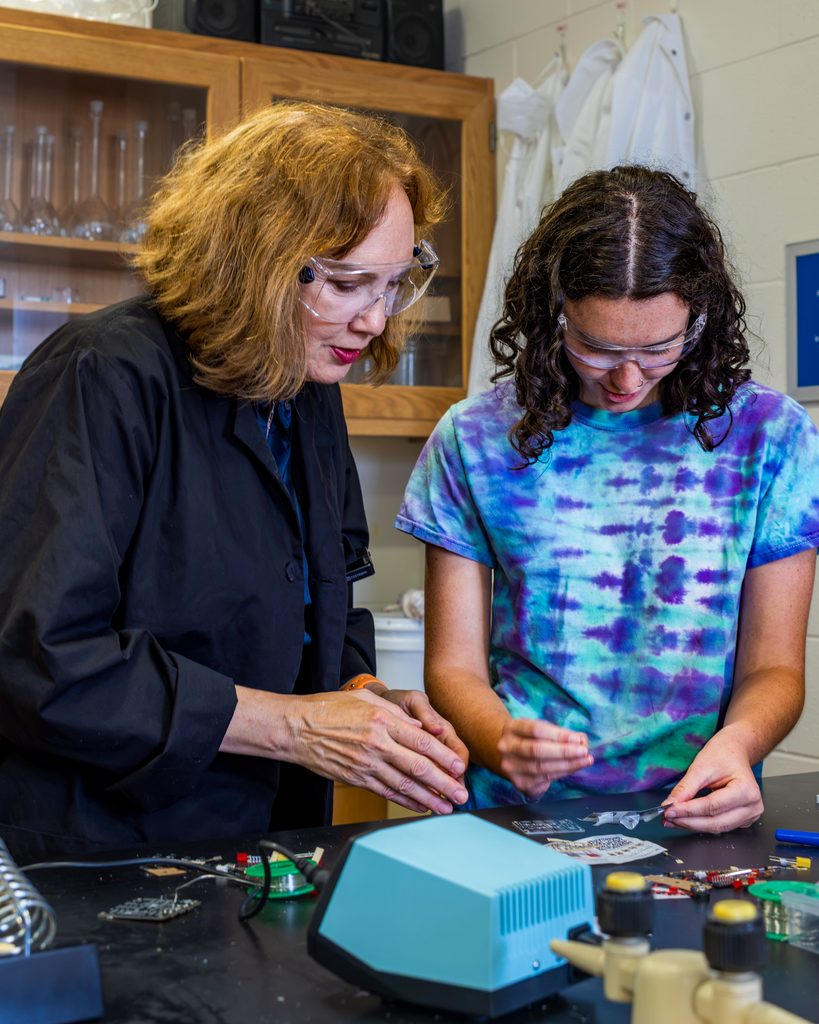
As provost at Ohio Wesleyan University, Crowley helped lead one of the university’s most ambitious periods of academic change, redesigning the curriculum, strengthening faculty development and launching new academic programs. Among the boldest of these efforts was the Conrades School of Engineering, which she helped establish through alumni philanthropy and industry partnerships. Its four-year mechanical engineering degree combines rigorous technical training with the benefits of a liberal arts education.
“Colleges have a responsibility to help solve the challenges facing their communities, our nation and the world,” Crowley said. “And employers increasingly need more than just technical skills. As tools like artificial intelligence evolve, we need graduates who combine technical expertise with critical thinking, ethical decision-making and the ability to see the human impact of what they build. That’s where a liberal arts education becomes an asset.”
It was this work—building connections between campus and community, between the liberal arts and meaningful careers—that clarified what Crowley wanted in her next chapter: to lead an institution whose mission and values made it possible to think audaciously about the future.
Enter Kalamazoo College and the search for K’s 19th president.
K’s spirit of collaboration, innovation and curiosity drew Crowley to the College, where that spirit is built into the curriculum and instilled in its undergraduates.
“K students strike me as people who are genuinely interested in the world,” she said. “They want experiences, not just credentials. They want purpose, not just preparation. I’ve spent my career at institutions that believe education should change the way students understand themselves and their place in the world. That belief is deeply woven into Kalamazoo College.”
Crowley sees opportunity everywhere here: in the city’s culture of reinvention and reinvestment, in the Kalamazoo Promise, and in relationships with local employers, nonprofit organizations, educational partners and alumni. She believes colleges are at their best when they are deeply connected to the communities around them.
“The future belongs to institutions that build bridges rather than walls, that become engines of possibility—for students, for communities and for society,” she said.
The Value Proposition
Crowley is candid about the headwinds facing higher education. Families are asking difficult questions about cost and value. Demographics are shrinking the pool of traditional college-age students. Technology is changing rapidly. Young people are entering adulthood in a world marked by polarization, uncertainty and loneliness—and they are feeling it.
“Students need knowledge, certainly. But they also need community, resilience, discernment, and the ability to navigate disagreement and complexity,” she said. “We create communities where students learn to live with people different from themselves, test ideas, build friendships, take risks, fail safely and begin again.”
Public confidence in higher education also remains low—just 38% of U.S. adults expressed strong confidence in it, according to a 2026 Gallup-Lumina study. It’s up to colleges and universities, Crowley argues, to help close the gap between public perception and the lived experience of their alumni.
“We know what our graduates do. We know how they contribute. We know employers value the skills they develop. Yet too often we wait for others to connect those dots. We can’t afford to do that anymore,” Crowley said. “Liberal arts colleges need to become translators. We need to explain our value clearly, confidently and repeatedly.”
Much of the national dialogue on higher education has centered on career training and the earning potential of different majors. Crowley emphasizes that career preparation and intellectual exploration—a hallmark of the liberal arts—are not competing priorities.
“One of the great strengths of a liberal arts education is that it allows students to discover what they love, what they are good at, and what kind of life they want to build—while also developing skills that employers consistently seek,” she said. “An education grounded in inquiry, communication, analysis, and adaptability prepares students not just for a first job but for a lifetime of meaningful work and citizenship.”
The Next Reinvention
Skepticism about higher education and the liberal arts is not what worries Crowley most. The bigger concern, she says, is complacency within the academy.
“The world is changing rapidly. Colleges that refuse to adapt will struggle.
“We need enough humility to ask where the public is right: College is expensive. Career pathways are not always clear enough. We should listen carefully and improve. Being an educational institution means we should model learning ourselves.”
For Kalamazoo College, some of those questions will inevitably involve the K-Plan and its evolution for the 21st century.
Long before experiential learning became a higher education buzzword, K built an educational model around it. Before study abroad became commonplace, K students boarded ocean liners to learn from the world itself.
“The K-Plan was one of the most influential educational ideas of the 20th century. It helped redefine experiential learning years before it became fashionable,” Crowley said.
Alumni feel a deep connection to the K-Plan, particularly study abroad, and a strong desire to preserve the experience for future generations.
“People often talk about tradition and innovation as opposites,” Crowley said. “I don’t see them that way. Most traditions begin because somebody asks, ‘What if?’ The best innovations deepen a mission rather than abandon it. The challenge is not preserving the past. The challenge is preserving the courage that created it.”
As Crowley leads K into its next era, she wants to cultivate that courage among faculty, staff and students: the courage to ask big questions about K’s mission and values, to listen carefully, and to identify opportunities to make K even stronger and more distinctive.
“The future isn’t something that happens to colleges,” she said. “It’s something we create together through courageous choices.”
Like many of its peers, K faces a period when tightened finances and competing priorities demand hard choices, so change, Crowley says, must start with building trust.
“People know when leaders are avoiding reality. They also know when leaders have no plan,” Crowley said. “During periods of uncertainty, people deserve honesty about the challenges and confidence that there is a path forward.
“My leadership philosophy is simple: Truth. Hope. Innovation. Joy. My job is to tell the truth about where we are, help people imagine what is possible, and then work together to build it.
“Jim Kouzes once wrote that the domain of leaders is the future. I believe that deeply. The responsibility of leadership is not simply to solve today’s problems. It is to protect and strengthen the institution for the students who are not here yet. That means thinking beyond the immediate moment, understanding trade-offs honestly, and making decisions that align with mission while keeping an eye on what the institution will need five, 10, or 15 years from now.”
Asked what she hopes to see by the end of her first year on campus, Crowley doesn’t hesitate: “I hope we have begun moving from conversation to action,” she said. “Most of all, I hope there is energy. Colleges do their best work when people believe the future can be better than the present and are excited to help build it.”
Ten years from now, Crowley wants K to be recognized not just for what it has done historically, but for what it is creating now.
“I hope we are known for innovation, experiential learning, meaningful work, civic engagement, and preparing students for a world that demands both expertise and humanity. I hope what remains unchanged is the belief that education should transform lives. Relationships matter. Mentorship matters. Being known matters. Those things should never go out of style.”
Beneath the planning and the priorities there is a steady conviction.
“I believe deeply in the mission of higher education. I believe students still hunger for purpose, connection, meaning and opportunity. I believe liberal arts colleges can help solve some of the most pressing challenges facing our democracy. The question is not whether we should change—the question is whether we are willing to lead.”
That energetic leadership—from imagination to action—may ultimately define her presidency.
Last spring, as Crowley was welcomed to campus, Stetson Chapel echoed with the history of Kalamazoo College. Dedicated on K’s 99th birthday, the chapel has witnessed nearly another century of change, each generation leaving its own mark while preparing the next to do the same.
Crowley understands this history well enough to know that K’s story has always been about moving forward: people willing to ask difficult questions, embrace bold ideas, and build something that did not yet exist.
What if?
For Kalamazoo College’s newest president, those two words are more than a slogan. They are how change begins.